

The Secret of Horror Game Sound: The Psychology of Silence and Principles of Silent Design
2026.05.23·Study·20 min readMUZIUM
#horror games#sound design#silence#game psychology#horror sound#ambient sound#tension#adaptive audio
Ngon ngữ khác:
English···

The Silence That's Scarier Than a Scream: Why Do We Tremble More When There's No Sound at All?
Have you ever had this experience while playing a horror game? The tense chase music fades away, leaving only the sound of the character's footsteps. Your palms sweat, and the hand gripping the mouse trembles slightly. In many horror scenes, the actual scream erupts at the moment the monster appears, but the point where real fear actually begins is often that brief silence when the music stops.
People commonly think that what makes horror films or games scary is the eerie music. But why do we feel deeper fear at the exact opposite moment, when sound has nearly disappeared? It's because silence isn't simply "the absence of sound" — it works through the contrast created when the auditory information that was laid down just before suddenly drops away.
This article covers the tension-building production created by "silence" and "ambient sound" within horror game sound design. It connects, in one flow, why silence becomes such a powerful psychological signal, how masterpiece horror games have emptied out sound, and a layer structure and 5-step workflow you can immediately apply to your own projects.
If you read to the end, you'll grasp the sound designer's perspective — not "what should I add more of" but "what should I take away."
Why Silence Becomes a Powerful Fear Signal: Perspectives from Neuroscience and Psychology
The Auditory Vigilance System: Silence Can Be an "Alarm," Not "Safety"
In human sensory processing, hearing is a channel well-suited for quickly alerting us to events outside our field of vision. In simple reaction tasks, reaction times to auditory stimuli are often measured as shorter than those to visual stimuli, and because hearing functions even in visual blind spots, it's known to engage early in threat assessment.
The amygdala (the brain's threat assessment center) — one of the core circuits of fear response — doesn't only respond to loud sounds. Multiple studies report that unpredictable changes in auditory context themselves can activate attention and arousal systems and induce threat assessment. However, this response doesn't involve the amygdala alone; several systems including prediction error, attention shifting, and uncertainty processing are involved together.
Compare it to a natural environment. The moment birds suddenly stop singing or insect sounds disappear in a forest is an abrupt cessation of background sound, and there's significant room to interpret it as a signal that something has gone wrong. The same structure operates within games. When ambience that has been playing for a long time suddenly disappears, the player's attention immediately expands to the entire environment, and tension levels can rise even without a jump scare.
💡 Practical tip: When using silence, I recommend "a state with minimized auditory cues" rather than "complete digital silence." Complete silence makes players suspect a disconnected headphone or a bug, but if a single layer of room tone (the subtle reverberation of a space) remains, players feel "the game is alive, but something has disappeared."
Information Gaps Amplify Imagination: How Negativity Bias Works
When auditory cues disappear, the brain doesn't stay still. It fills the empty space with hypotheses. And in ambiguous situations, those hypotheses tend to lean toward threat. In cognitive psychology, this is called negativity bias. Even with identical ambiguous stimuli, humans weight potential danger more heavily than safety in their interpretation.
It's the same principle as why horror films are scarier when they don't show the monster until the end. In the 1975 film "Jaws," the shark reportedly appears on screen for a total of about 4 minutes during its roughly 124-minute runtime. "The Blair Witch Project" never directly shows the witch's true form even at the conclusion. This is because the audience's imagination paints a scarier picture than any special effect could.
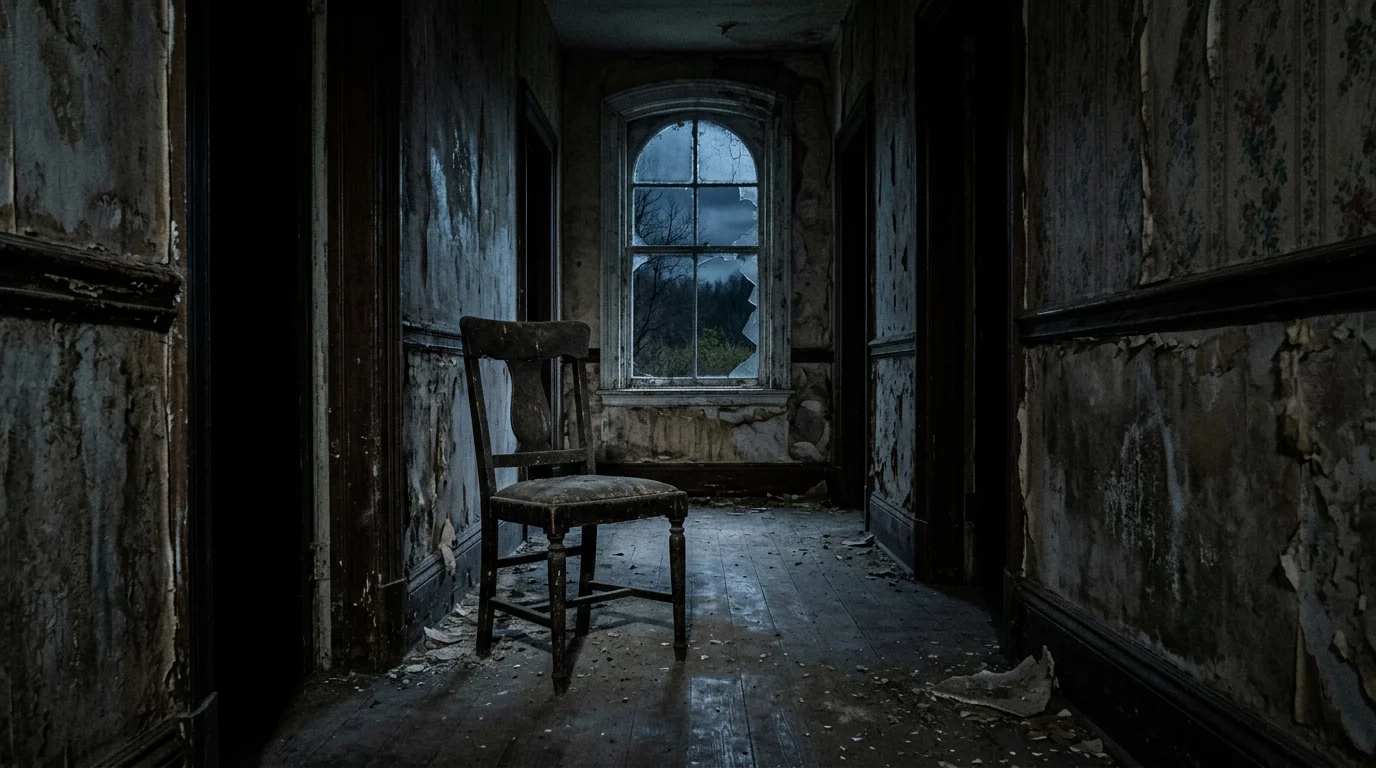
In games, silent sections are devices that maximize this imagination-amplifying effect. The moment footsteps that were audible suddenly stop, the player automatically interprets it as "the monster has stopped and is looking at me." In the actual code, the monster may simply be paused at one point on its patrol path, but the player's brain actively creates threat scenarios to fill that empty space.
Horror with Music vs. Horror in Silence: They Work Differently
Horror with music is closer to an "emotional guide." Dissonance, low-frequency drones (sustained low tones), and sudden stingers (short impact sounds) tell the player, "This is a horror scene right now." It's friendly guidance, but it also has the effect of setting an upper limit on the fear. This is because players learn that the threat is over when the music ends.
In contrast, horror in silence offers no guide. Players must judge for themselves "am I safe now, or in danger?" This judgmental burden itself creates cognitive load, and cognitive load translates directly into tension. Film music research generally explains that music engages with emotional cues and helps form expectations about a scene. Increased predictability can mean a loss from the perspective of horror direction.
Category | Horror with Music | Horror in Silence |
|---|---|---|
Emotional guide | Clear | Nearly none |
Predictability | Relatively high | Very low |
Cognitive load | Moderate | High |
Duration | Short and intense | Long and cumulative |
Suitable situations | Jump scares, boss fights | Exploration, stealth, everyday spaces |
In practice, combining the two is closer to the answer. You can stack music as a threat becomes imminent, then paradoxically remove the music just before the climax. The greater the dynamic range (the difference between the quietest and loudest sounds) created by the rise and fall of sound, the greater the player's emotional amplitude.
💡 Practical tip: Try the formula "build tension with music, hit the climax with silence." The moment the chase BGM that has been playing for a while suddenly cuts off, the player's brain simultaneously processes both "I'm safe now" and "something worse is about to happen."
How Masterpiece Horror Games Designed Silence: Silent Production Through Case Studies
Silent Hill: The Asymmetric Contrast Between Radio Noise and Silence
The Silent Hill series is a work that elevated the term "sound design" into a core vocabulary of horror games. Composer Akira Yamaoka has reportedly expressed in multiple interviews and lectures a work philosophy of creating fear through silence, emptiness, and unpredictable sound structures rather than richly filling out melodies. His sound has a structure where industrial noises, metal friction sounds, and long silences intersect.
Silent Hill's iconic radio noise is frequently cited as a representative example of silent design. When a monster approaches, white noise flows from the protagonist's small radio; when it moves away, silence returns. The clever aspect of this system is that rather than the noise itself being the threat, the moment the noise disappears becomes the start of the next silence. The player learns to be wary of both the noise and the silence.
Especially in Silent Hill's streets where vision is restricted by thick fog, the structure that forces reliance on hearing over sight doubles the effect of silence. When you can't see and can't hear, the player wavers between "is there really nothing here?" and "did I miss a danger?"
Outlast and Amnesia: Designing Silent Sections After Pursuit
"Amnesia: The Dark Descent" (2010, Frictional Games) and "Outlast" (2013, Red Barrels) are frequently mentioned as works that established the representative grammar of chase-based horror. Both games share the commonalities of first-person perspective, weaponless escape, and powerful sound design.
A particularly notable pattern is the silent section immediately after a chase sequence. When the monster disappears from sight and the chase music fades out, the game immediately returns to a state filled only with calm environmental sounds. At this point, the player is often hiding in a closet or locker, and in the silent section where music has disappeared, only the character's ragged breathing remains.
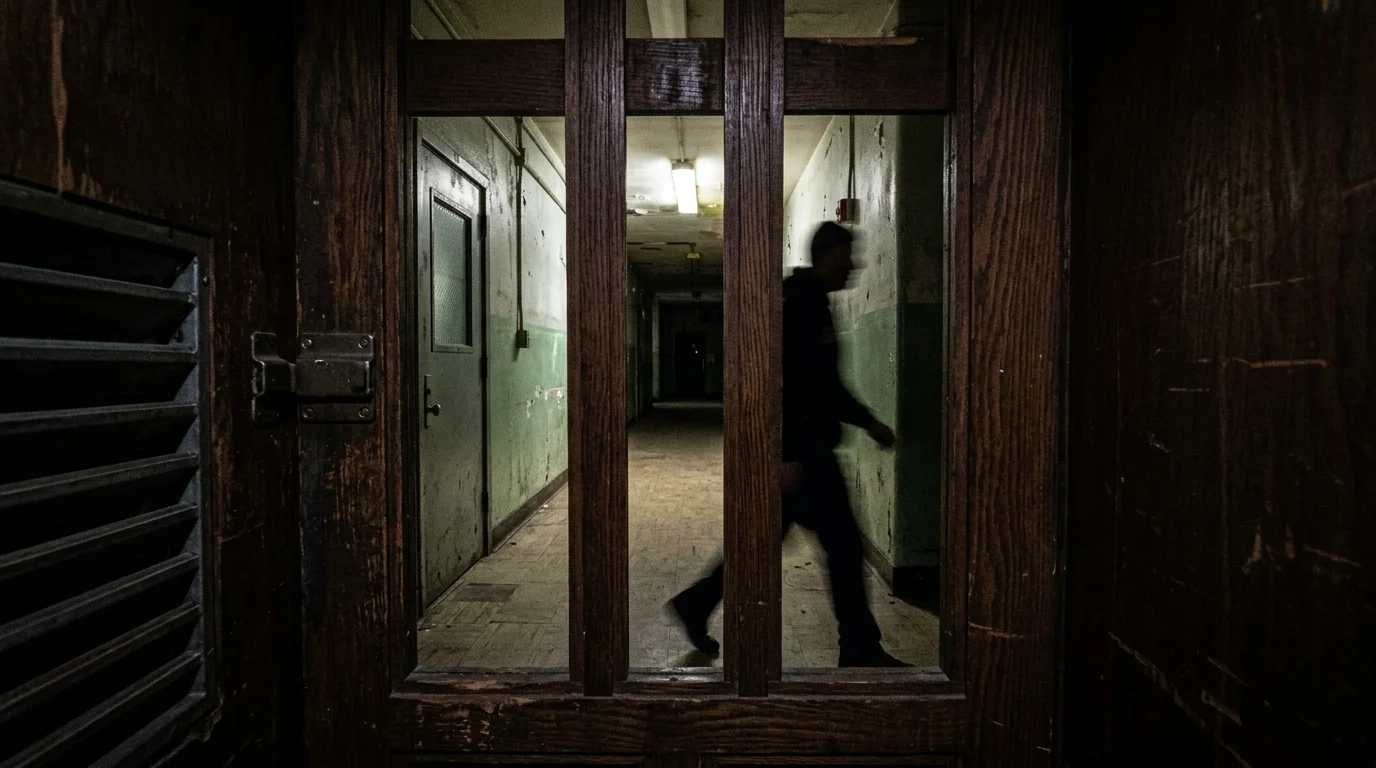
The core of this design lies in conveying the message "the pursuit is over but the fear is not" without music. The player must decide for themselves when to open the closet door and come out, and every moment of postponing that decision becomes an extension of fear. As the learning accumulates that you can't be sure of safety unless the music plays again, silence itself becomes a trigger for fear.
💡 Practical tip: Try maintaining a silent section for a certain time after the chase BGM ends. If you switch to peaceful music too quickly, the player feels "the game is over," but if you drag out silence long enough, the suspicion "I just haven't been discovered yet" grows.
Alien: Isolation and P.T.: The Evolution of Adaptive Sound Systems
"Alien: Isolation" (2014, Creative Assembly) is regarded as a work that seriously introduced adaptive audio (a sound system that changes in response to player state) to horror. It's also known for its dual AI structure: an upper-level Director AI provides search direction and hints to the Xenomorph, but doesn't directly share the player's exact location. The Xenomorph itself tracks and responds to the player's movements and noises through visual and auditory sensory models.
Thanks to this structure, the sound system can also operate as a result of actual AI behavior rather than scripted cues. What's interesting is that when the Xenomorph is nearby, rather than aggressively raising the music, choices to remove the music and leave only environmental sounds, footsteps, and breathing appear frequently. Players must interpret threat signals directly without artificial music guidance.
Hideo Kojima's "P.T." (2014) is short in length but extremely dense in sound design. On top of the simple structure of repeatedly walking the same L-shaped corridor, radio voices, background noise, sudden silences, footsteps, and clock chimes are elaborately arranged. The moment the news voice flowing from the radio suddenly cuts off is frequently cited as a scene that creates strong fear without a jump scare.
The commonalities of these three works can be summarized as follows.
There is clear intent in the decision to remove music: Silence is the result of design, not accident.
One layer of environmental sound is generally kept in silent sections: Complete digital silence is avoided.
Sound responds to player behavior and AI state: It's not static BGM cues but system-level adaptive design.
💡 Practical tip: If you don't have the bandwidth to fully implement adaptive audio, try connecting just three variables to sound cues: "player health," "monster distance," and "zone entry." Using just these three variables well can create deeper immersion than fixed BGM.
The Tug-of-War Between Ambience and Silence: Sound Layer Structure That Creates Tension
The Role of Ambience: The Low-Frequency Technique That Creates "Safe Silence"
Horror game sound usually consists of three layers. The music layer, the environmental sound (ambience) layer, and the individual sound effects layer. Of these, the one most deeply intertwined with silent design is the environmental sound layer.
The core of environmental sound is that it's audible to the point of being inaudible. Elements like low-frequency drones, room tones, distant wind sounds, and the subtle creaks of building structures are layered in a state where the player doesn't consciously perceive them. In practice, it's known that environmental sound is often layered at a volume sufficiently lower than dialogue and action effects, with the center of gravity placed on low and low-mid frequency ranges. Absolute decibel values vary depending on the project's loudness target and platform normalization policy, so rather than transplanting externally circulated numbers as-is, it's safer to adjust based on values measured from your own build.
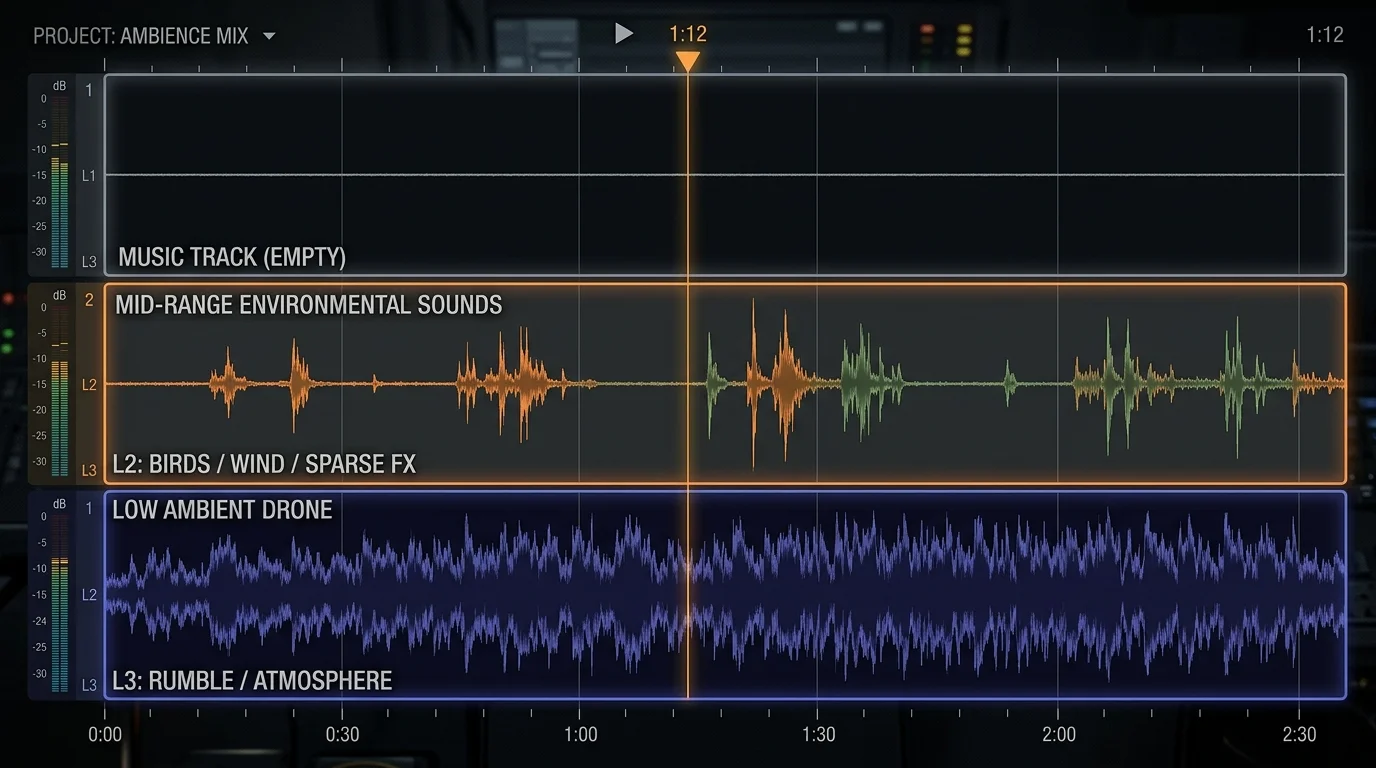
This state of layered environmental sound is learned by the player as "the normal state where the game is alive." And precisely because of this learning, the moment you reduce the environmental sound by one notch or remove a specific frequency range, the player's brain immediately detects an abnormal signal. There are also reports that subtle changes in environmental sound stimulate deeper unconscious vigilance than removing the music.
The Drop-out Technique: The Formula for Intentionally Removing Sound
Drop-out is a technique that intentionally removes some or all of the sound layers. It's frequently cited as a tool that produces strong effects in horror sound design.
Before (typical monotone design): Ordinary corridor → Tension music fades in → Monster appears → Jump scare sound effect → Music fades out → Ordinary corridor
After (Drop-out applied example): Ordinary corridor (ambience layered) → Subtle footsteps added in the distance → Both ambience and footsteps suddenly disappear (brief silence) → Only the character's breathing remains → A single sound effect from behind → Only ambience fades in again
The latter generally creates stronger tension. There are two reasons. First, the player's auditory sensitivity naturally increases during the silent section. Second, because a single sound effect explodes on top of that heightened sensitivity, the perceived intensity is greater even at the same volume.
Principles that sound designers frequently use as a starting point for prototyping are as follows. It's safer to receive them as guidelines that presuppose project-specific adjustments rather than absolute formulas.
Stack enough before removing: Layer environmental sound for a certain time so the player's hearing adapts to the "normal state," then remove it.
Remove fast, bring back slow: An asymmetric design where it disappears in a short, fast manner and returns with a long, slow fade-in is frequently used.
Manage the silent section length from both ends: If too short, it's perceived as coincidence; if too long, it tends to be suspected as a bug or audio dropout. The appropriate length varies by chapter tone and player movement, so it must be found through playtesting.
Prepare a single sound immediately after the silent section: Empty silence alone tends to weaken the effect. There must be a small but clear single sound cue at the point where silence ends to complete the fear.
💡 Practical tip: The single sound introduced immediately after Drop-out doesn't need to be deliberately loud. Rather, low-volume small sounds, or sounds coming from off-screen directions, are often effective. The player's brain interprets ambiguous signals like "small but definitely audible" as most threatening.
Common Mistakes and Solutions: How to Avoid Moments When Silence Becomes Boring
Mishandling silence leads to boredom rather than fear. Here are common mistakes and solutions seen in practice.
Mistake 1: Dragging silence too long Players find it hard to endure complete silence beyond a certain time. The first few seconds are tension, but as time lengthens, they start to suspect the game. The moment meta-cognition kicks in — "is the audio cut, is this a bug" — immersion breaks. Solution: Set a maximum silence threshold by project standard, and when you must drag it beyond that, layer at least one line of bodily sound like character breathing or heartbeat.
Mistake 2: Mixing that ignores dynamic range If you set all sounds to similar volumes, the effect of silence disappears. If everyday environmental sounds are too loud, silent sections don't stand out, and if jump scare effects are at similar volumes to everyday environmental sounds, the shock weakens. Solution: Clearly separate the volume stages of environmental sound, tension music, and jump scares. You must secure sufficient sound pressure difference between environmental sound and impact sound for the contrast between silence and shock to come alive. The absolute value of appropriate spacing varies depending on the project's loudness target and platform normalization policy, so rather than directly applying external recommendations, it's safer to set it based on actual perceived differences at the build stage.
Mistake 3: Repetition of the same silence pattern If you repeat the "post-chase silence" pattern in the same way throughout the game, players learn it. Learned patterns are no longer scary. Solution: Intentionally scatter the length of silence, the type of sound immediately after silence, and the frequency of silence occurrence. Taking a different sound concept itself per chapter is also a good method. For quick verification, I also recommend creating three versions of the same scene — "no silence / short silence / long silence" — and having about five people play them. Observing which version draws the deepest sigh gives you more consistent signals than subjective surveys.
Mistake 4: Mixing that only considers headphone environments Sound designers usually work with studio headphones, but actual players play games in various environments including laptop speakers, low-end earphones, and TV speakers. Environmental sounds concentrated in low frequencies may be barely audible on laptop speakers. Solution: At the final mixing stage, check with laptop speakers and smartphone speakers. The contrast between silence and sound must be maintained even in environments where low frequencies aren't audible.
A 5-Step Workflow to Immediately Apply Silent Horror Design to Your Game
Steps 1-2: Fear Curve Mapping and Silent Point Placement
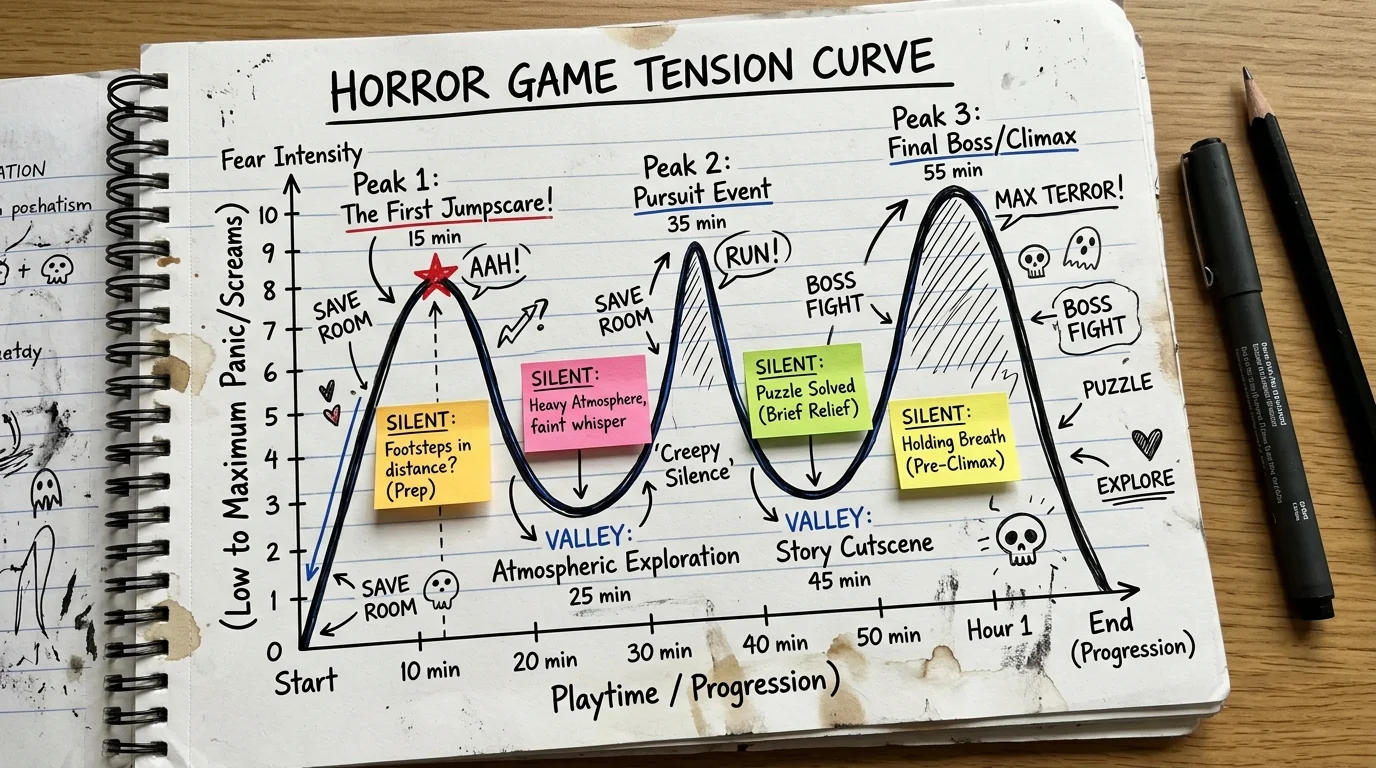
Silent design is closer to a result of structure than intuition. The first thing you must do is visualize the game's fear curve (tension curve).
Step 1: Fear Curve Mapping Place playtime on the horizontal axis and fear intensity (010) on the vertical axis, then draw a curve by plotting the game's major events as dots. Assign estimated values such as 23 for chapter introductions, 34 for normal exploration, 67 for threat appearance, 8~9 for pursuit, and 10 for jump scare peaks. Drawing this curve lets you see at a glance how fear is distributed throughout the game. If the flat sections are too long or the peaks too frequent, you need to redesign the curve.
Step 2: Silent Point Placement Once the fear curve is laid out, place silent points on it. Placement at the following three positions generally produces good effects.
Middle of the rising section (fear intensity 5~6): A signal that a threat is imminent. Reduce the environmental sound by one notch to raise the player's auditory sensitivity.
Just before the peak (fear intensity 7~8): Right before the jump scare. Remove all layers and leave only a single sound.
Descending section (fear intensity 8 → 4): Right after the threat disappears. Remove the music and leave only environmental sound to maintain the ambiguity of "it's not over yet."
Steps 3-4: Practical Implementation Using Middleware
Once you've placed silent points on the curve, the next step is implementing them in the game engine. Many commercial games use audio middleware like Wwise (Audiokinetic) or FMOD. Both tools support parameter-based sound control, so you can dynamically manipulate sound based on game variables.
Step 3: Parameter Design First define the game-side parameters that will control the sound. Parameters frequently used in horror games include the following.
PlayerStress(0~100): A stress index combining health, oxygen level, pursuit status, etc.EnemyDistance(meters): Distance to the nearest enemyZoneSafety(0~1): The safety rating of the current zoneLightLevel(0~1): The lighting intensity the character is exposed to
Connect these parameters to sound cues. For example, when EnemyDistance drops below a certain value, set the music layer volume to 0 while simultaneously raising the volume of the character's breathing sound.
Step 4: Implementing Drop-out Triggers Silent sections aren't sufficient with simple volume fades alone. You must also use event-based triggers. Wwise can "switch the entire sound environment at once under specific conditions" through its State and Switch systems, and FMOD through its Snapshot system.
Example: The moment the player hides in a closet, a 'Hiding' snapshot is triggered, the music layer immediately attenuates significantly, a low-pass filter (a filter that blocks high frequencies) is applied to the environmental sound to make it sound muffled, and only the character's breathing sound is highlighted. When you leave the closet, it returns to the 'Normal' snapshot over several seconds.
💡 Practical tip: If you're new to middleware, consider FMOD Studio's free indie license first. It's known to provide free licenses to small projects that meet official indie license conditions such as annual revenue and development budget (license conditions are subject to change, so checking the latest policy on the official FMOD website is recommended). Wwise is more powerful but has a steeper initial learning curve.
Step 5: Playtesting and Measurement
The final step 5 is verification. Sound designers' intuitions are often wrong. Without measuring actual player reactions, it's common for scenes you believed would be scary to draw no reaction at all.
Diversify the playtesting environment Test the same build in at least three environments.
Studio headphones + dark room: The optimal environment the designer intended
Laptop built-in speakers + normal lighting: A typical play environment
Smartphone speakers or low-end earphones: The lowest-spec environment
Verify that the effect of silent sections is maintained in each environment. Especially since laptop speakers barely reproduce low frequencies, environmental sound that relies only on low-frequency drones may show little perceived difference from silence.
Measurement metrics There are roughly three ways to measure fear intensity.
Subjective surveys: Have the scariness level of each chapter rated on a 5-point scale. The easiest but vulnerable to response bias.
Physiological responses: Physiological indicators such as heart rate variability and skin conductance (GSR/EDA) are useful for relative comparison of fear/arousal responses. Smartwatch heart rate data can also be used as a supplementary indicator, but since it's affected by wear status, latency, and error, it's safer to treat it as a supplementary "relative comparison" indicator rather than precise measurement.
Behavioral data: Collect logs such as how long players stay still in specific sections, the average time hiding in closets, and changes in mouse movement speed. Behavioral data can also be mixed with variables like difficulty, navigation failure, and fatigue, so it should be interpreted alongside surveys, observation, and video.
Decision-making differences between novice and skilled designers
Decision item | Novice designer | Skilled designer |
|---|---|---|
How to intensify scary scenes | Add music, add sound effects | Remove existing sounds, expand dynamic range |
When BGM feels awkward | Replace with stronger BGM | Remove BGM entirely, leave only environmental sound |
Just before a jump scare | Tension music crescendo | Empty with brief silence |
After pursuit ends | Relieving music | Silence or environmental sound only |
Measurement method | Mainly own listening | Multiple playtests + behavioral logs + physiological indicators |
What this table shows is simple. Skill in sound design is the judgment about what to take away, not what to add.
💡 Practical tip: When recording playtest video, capture both the screen and the player's face and hands. The moment shoulders hunch up, the moment a hand falls from the mouse, the moment they hold their breath — these are the points where real fear has worked. Video catches the data that surveys miss.
Silence Is Not Empty Space — It's the Most Sophisticated Instrument
Let me summarize the core of this article in three lines.
Silence becomes a powerful signal not by itself but through the contrast created when the auditory information that was laid down just before suddenly drops away, with negativity bias and information gaps amplifying that effect. Silent Hill's radio noise, the post-pursuit silence of Outlast and Amnesia, and Alien: Isolation's adaptive audio and dual AI structure all place "the timing of removing sound" at the center of design. Train players to learn the normal state through the environmental sound layer, create asymmetric contrast through the Drop-out technique, and then place silence at precise coordinates on the fear curve — this is the practical workflow.
Let me suggest one small action you can try today. Pick one scene from your favorite horror game, and listen to the sound separately. Check when music plays and when it disappears, at what moment environmental sound drops by one notch, and how many seconds of silence are maintained just before a jump scare. Doing this for just 30 minutes lets you directly feel the elaborate texture of sound design you usually pass by without notice.
Sound design is ultimately not the art of addition but the art of removal. Before agonizing over what to make people hear, the designer who decides what NOT to make them hear creates deeper fear. I hope "silence" becomes the most sophisticated instrument in your next project.