

The Line AI Voice Can't Cross: Why Human Voice Actors Still Matter
2026.02.26·Study·16 min readMUZIUM
#ai voice#human voice actor#voice acting#emotional performance#audio production#dubbing#tts#voice over
Also available in:
English···

Can AI Replace My Voice?
You've probably heard the phrase "AI is stealing voice actors' jobs" at least once.
ElevenLabs, Clova Dubbing, Adobe Podcast… We live in an era where a convincing voice can be produced with just a few clicks. Even in audio production settings, the question "Can't we just handle it quickly with an AI voice?" comes up quite often. Aspiring voice actors feel anxious about the future, and production directors find it hard to know where to allocate their budgets.
The reason so many people stall at this crossroads isn't a lack of information. It's because there's no practical, clear-cut standard for comparing the differences between AI voices and human voice actors.
This article takes an objective look at how far AI voice synthesis technology has actually come, and specifically analyzes what only human voice actors can do across three axes: emotional expression, performance, and collaboration. By the end, you'll have a clear framework for deciding when and how to use AI versus a voice actor in your projects.
How Far Has AI Voice Technology Come?
The Current State of Technological Progress: No Longer a "Robot Voice"
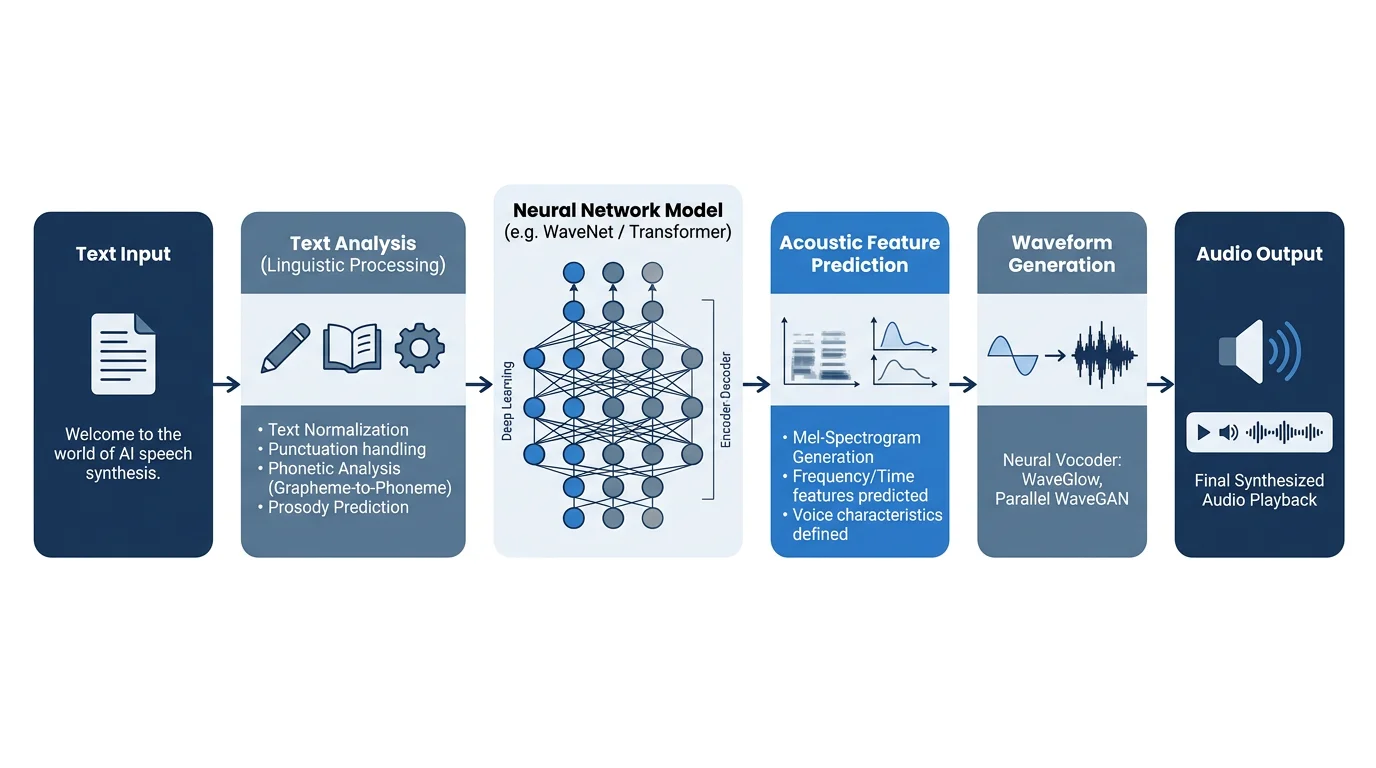
When Google unveiled WaveNet in 2016, the industry was stunned. While conventional speech synthesis stitched together phonemes using rule-based methods, WaveNet used deep learning to generate waveforms directly. The result was a notably improved naturalness score (MOS, Mean Opinion Score) compared to previous TTS systems. According to the WaveNet paper Google published in 2016, WaveNet achieved a MOS score more than 0.5 points higher than conventional concatenative TTS in English speech evaluations.
Eight years later, the level of technology has shifted once again. ElevenLabs lets you select an emotional tone (sadness, excitement, whispering) with just a few lines of text to generate a voice. Microsoft Azure Neural TTS uses SSML (Speech Synthesis Markup Language) tags to finely adjust emphasis, speed, and pause placement, supporting over 100 languages and dialects. OpenAI's TTS model offers six voice characters and has reached a point where average listeners struggle to distinguish AI from a real person in terms of intonation naturalness.
The changes in cost and speed are even more dramatic. Commissioning a human voice actor for five minutes of narration audio requires several hours including recording and editing, plus associated costs. AI tools output the same amount in a matter of seconds. This is why AI has rapidly become the standard in areas that require mass production — product manuals, multilingual e-learning content, and chatbot response audio.
Walls Still Uncleared: Emotional Precision and Contextual Interpretation
The more technology advances, the more clearly certain limitations come into focus. That limitation is emotional precision and the ability to interpret context.
The way current AI voice tools set emotion is fundamentally label-based. You adjust sliders or select presets — something like "40% sadness, 60% warmth." But in real acting, emotion is not categorized by labels.
Consider a hypothetical scenario. In a farewell scene, the protagonist says "I'm fine." Those words need to carry completely different emotions depending on the situation. Whether it's an "I'm fine" meant to comfort the other person, an "I'm fine" used to reassure oneself, or an "I'm fine" tinged with resignation — that distinction can only be determined by understanding the full context of the script and the emotional arc of the character. An AI will read those words with a consistent sad tone once the "sadness" label is applied. But the emotion that scene demands may be something complex — sadness, resignation, and tenderness all coexisting at once.
Another limitation is spontaneity. In a recording session, if a director asks, "For this part, try holding your breath a little longer and then letting it burst out," a skilled voice actor immediately connects that instruction to their own physical senses and delivers a different result. Translating the same instruction into text and implementing it through SSML for an AI requires the intervention of a technical specialist and repeated rendering. This difference in response speed and flexibility has a direct impact on perceived efficiency on the production floor.
💡 Practical Tip: Before starting a project, use these three questions to quickly assess whether AI is a good fit.
- Emotional Intensity: Does the project include scenes where the listener needs to be moved to tears or have their heart racing? → A human voice actor is essential.
- Revision Frequency: Are you expecting more than three rounds of client feedback? → A human voice actor may be more cost-effective overall.
- Volume and Uniformity: Do you need mass production of content with low emotional variation, like hundreds of short informational prompts? → An AI voice is the efficient choice.
Three Core Elements of Voice Acting That AI Cannot Imitate
First: Contextual Emotional Interpretation — The Ability to Read Between the Lines
Great voice acting begins not with "reading" a script, but with "understanding" it. Before recording, a professional voice actor reads the entire script, mapping the character's emotional arc, the scene's structural position (is it the opening or the climax?), and even designing the emotional response of the target audience. This process is essentially identical to how a stage actor analyzes a script.
Let's take an advertising dubbing session as an example (hypothetical scenario). A narration script for an insurance company's ad contains the line "We protect your tomorrow." On the surface, it's a simple brand message — but if the preceding scene in the ad depicts a worried parent with young children, the narrator must carry the weight of that emotion forward, delivering both reassurance and trust in the word "protect." This is emotional design not written in the script.
An AI can read this sentence in a "confident tone." But connecting the emotional context of the previous scene by "remembering" it and weaving it into the nuance of delivery is beyond what current technology can do. AI processes at the sentence level; it does not accumulate emotion at the narrative level.
Second: Micro-Expression in Voice — Elements That Cannot Be Specified in Text
Many of the elements that create genuine impact in voice acting are difficult to specify through text. The tools a skilled voice actor employs include the following:
The timing of breath: The inhale just before a line, the subtly shifting intensity of an exhale as emotion builds. This breath is not consciously perceived by the listener, but it creates a physical resonance within them.
The density of pause (間): Whether there is a 0.3-second pause or a 0.8-second pause before the words "I love you" completely changes the emotional weight. AI tools can specify a pause using an SSML tag, but whether that pause conveys "hesitation" or "the lingering certainty of conviction" is a spontaneous judgment made within the context of what comes before and after.
Changes in vocal tract texture: A slight tightening of the throat, a resonance rising from deep in the chest, a barely perceptible nasality as though holding back tears. These textures arise naturally when an actor physically generates the emotion within their own body. AI can statistically reproduce patterns learned from data, but it does not generate that texture as a "living sensation."
Research in the field of speech emotion recognition consistently shows that human emotional expression is composed of dozens of subtle parameters beyond pitch, energy, and speech rate alone. Studies based on the Geneva Appraisal Questionnaire have found that even with identical text, various acoustic parameters — including formant frequencies, jitter, and shimmer — differ significantly depending on the speaker's emotional state. While AI models can learn to pattern-match these from training data, fully reproducing the spontaneous micro-variations that arise from an actual emotional state remains a current technological limitation.
💡 Practical Tip: If you want to test a voice actor's emotional range during a casting audition, ask them to read the same sentence in three different emotional states. Example sentence: "This is the last time." — ① with anger, ② with sadness and resignation, ③ with tender care for the other person. If you listen to all three and each one feels distinctly different, that's a signal the voice actor possesses both emotional range and technical control.
Third: Real-Time Collaboration with a Director — The Value of Living Communication
The quality of audio production isn't decided inside the booth. It's shaped through the conversation between the director and the voice actor.
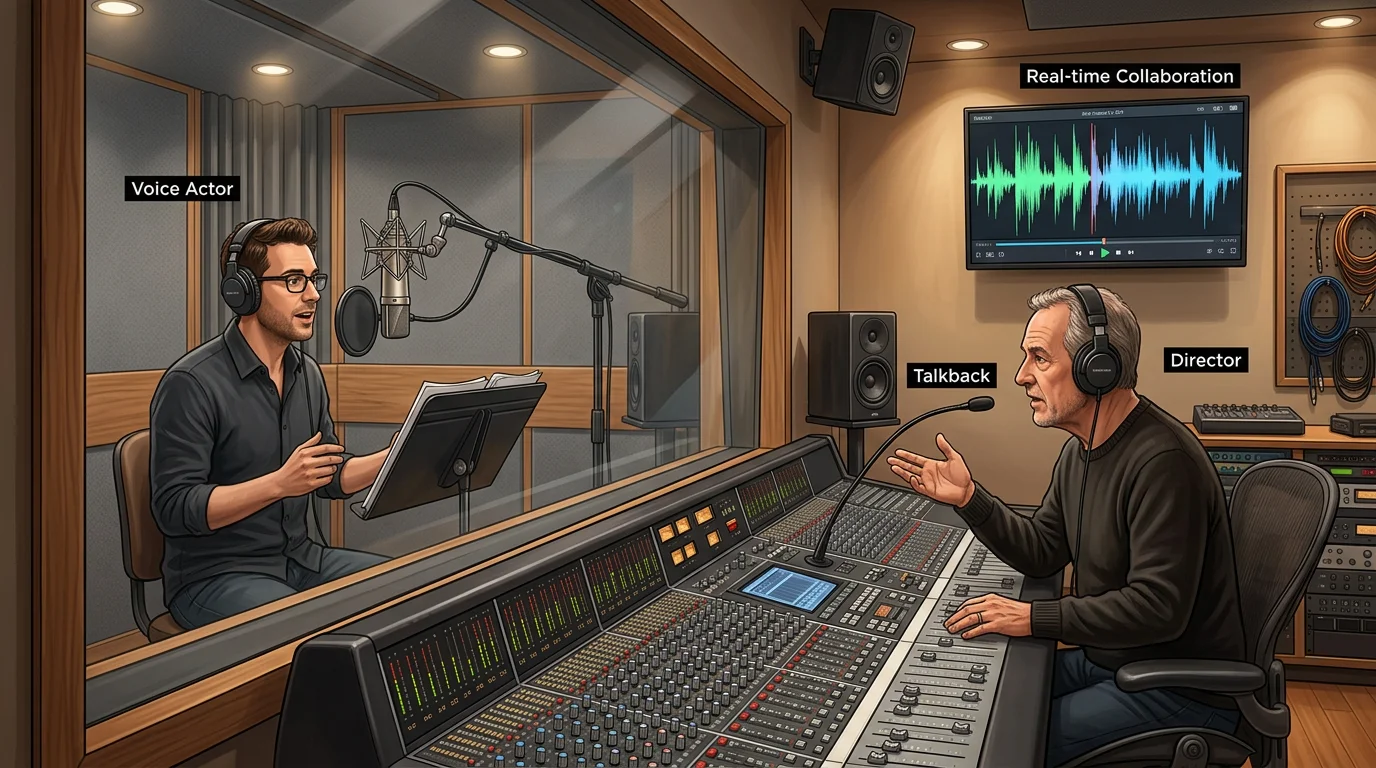
In a typical recording session workflow, the director's feedback begins after the first take. This feedback is expressed in language — "a little brighter," "bring the last syllable down," "pause just briefly on that word" — but each instruction carries a significant amount of sensory information. A skilled voice actor instantly translates these directions into their own body and senses.
This process isn't "revision" — it's co-creation. The director's visual imagination and the voice actor's auditory interpretation meet, giving rise to emotional layers that weren't in the script. As collaboration sessions accumulate, the director comes to understand the voice actor's characteristics and strengths, and the voice actor internalizes the brand or project's emotional sensibility. This accumulation is what builds the audio identity of a long-term project.
In workflows that use AI voices, this process is replaced by "parameter adjustment." Parameter adjustment isn't inherently bad, but it is optimization within an already-defined range. It doesn't expand the creative possibilities themselves.
Genre-by-Genre Practical Comparison: AI vs. Voice Actors in Dubbing, Advertising, and Audiobooks
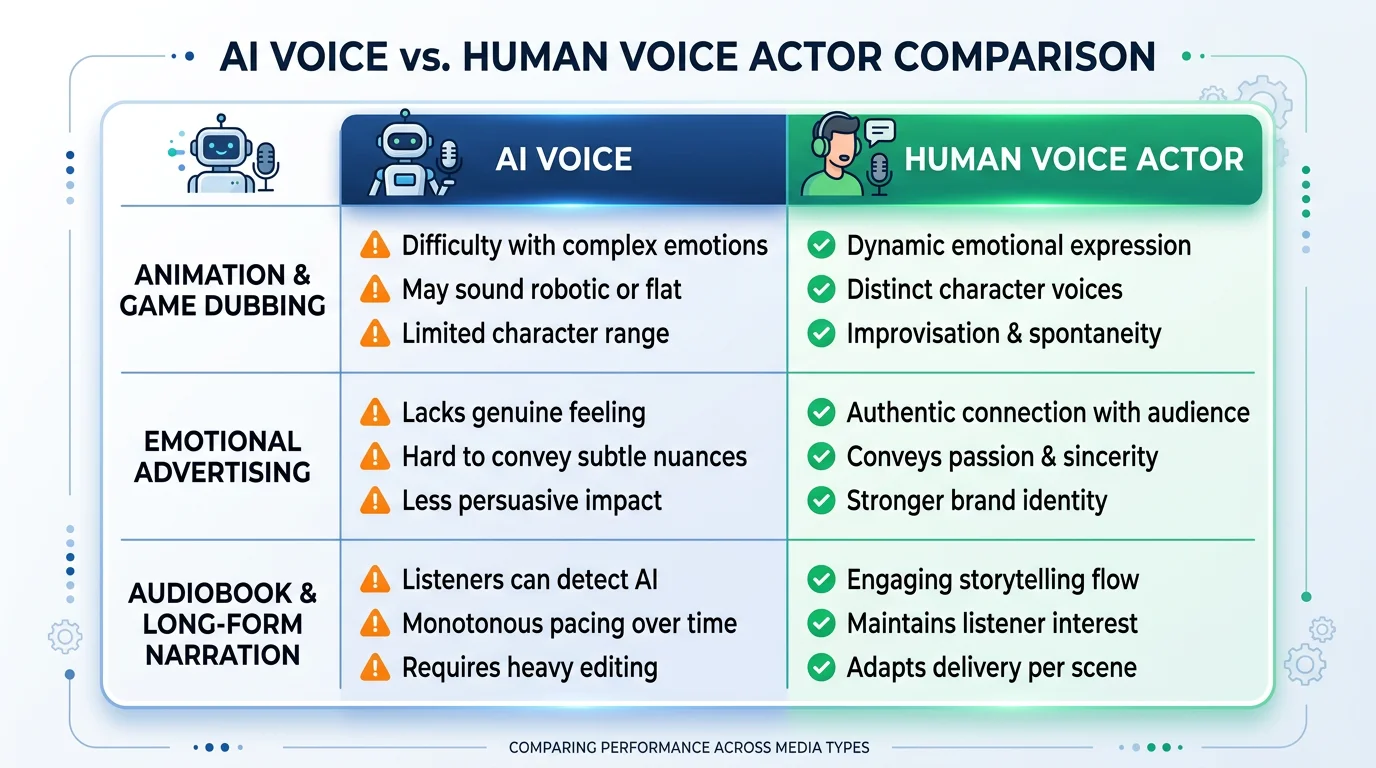
Animation & Game Dubbing: Where Does a Character's Vitality Come From?
Animation and game dubbing are among the areas where AI voices face the greatest challenge. That's because it requires not just conveying simple emotions, but embodying **character identity** through voice.
Game dubbing is especially complex. The same character must sound sharp during combat, carry both exhaustion and warmth in a fireside conversation, and express resignation and peace in a scene just before death. Each of these emotional states must be housed within one consistent character voice. A voice actor maintains this consistency through the process of "wearing" the character.
Looking at actual industry examples, the Japanese animation dubbing market actively debates the adoption of AI voices, yet continues to use professional voice actors for major productions. In 2023, the Japan Association of Voice Actors (日本音声製作者連盟) published guidelines on AI voice cloning and publicly stated that "emotional authenticity is a unique capability of human voice actors." This offers a telling glimpse into how the industry views the role of human voice actors, regardless of technological progress.
There are certainly areas where AI is used efficiently in game dubbing. Lines where information delivery takes precedence over emotional expression — background dialogue for NPCs (Non-Player Characters), repeated notification messages, tutorial guidance — are clear examples. Using AI for these lines allows budgets to be concentrated on the dubbing of core characters.
Emotional Ad Narration: The Voice of Brand Trust
Ad narration must move the listener's emotions in a specific direction within a very short span of time. Building brand trust, earning consumer empathy, stimulating the desire to purchase — all of it rests on a single voice.
The type of advertising where AI voices work relatively well is informational ads — cases where the clarity of information matters more than emotion, such as product specs, pricing, and event announcements. On the other hand, AI's limitations become pronounced in brand emotion ads, social message ads, and storytelling ads.
This is especially true for ads where meaning is created through the contrast between silence and sound, and through the white space between sentences. For instance, a line commonly used in insurance and financial ads — "We care about your family" — cannot be conveyed through pace and tone alone. Listeners resonate with it only when they can sense the texture of someone who has actually thought about their own family behind the voice. That is a texture that comes from lived experience, and it differs from a pattern learned from data.
💡 Practical Tip: When production budgets are limited, consider a hybrid workflow. Use AI to generate a narration draft of the full script to first align direction with the client, then cover only the high-intensity emotional moments — climaxes, brand slogan readings, the moments just before an emotional peak — with a human voice actor. This approach reduces costs compared to hiring a voice actor for the entire audio, while filling the emotional gaps that arise from using AI alone.
Audiobooks & Read-Aloud Content: A Voice That Accompanies the Listener for 3–10 Hours
Audiobooks are a genre where AI voice limitations accumulate and become evident over time. Unlike a short commercial, the listener spends several hours with the same voice. Throughout that time, the voice becomes not just a delivery medium, but a reading companion.
Findaway Voices (now under Spotify) announced in 2022 that it would allow the distribution of AI-generated audiobooks. Since then, the proportion of AI audiobooks has been growing across multiple platforms, including Audible. At the same time, review systems have continued to see reader responses like "the voice feels cold" and "there's no emotion."
This shows that the quality standard in audiobooks is not simply pronunciation accuracy. For full-length novels, a voice actor must distinguish between dozens of character voices while maintaining a consistent narrator's voice throughout. The emotional contrast between characters, the tonal shifts at chapter transitions, the calibration of tension during crisis moments — all of this must be sustained consistently across dozens of hours. Current AI shows clear limitations when it comes to maintaining this kind of long-term narrative coherence.
Strategic Positioning for Voice Actors to Thrive in the Age of AI
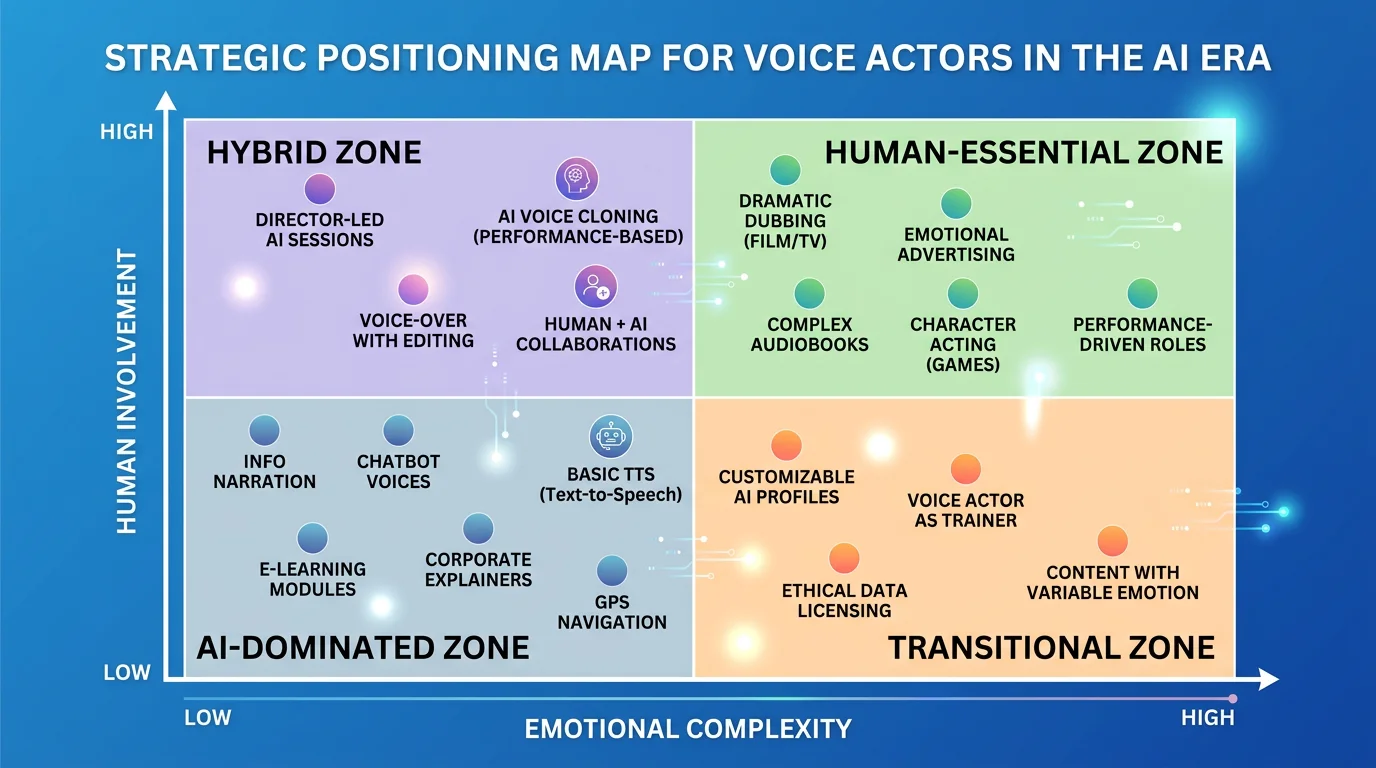
Specializing in Emotional Performance: Building Depth in the Territory AI Cannot Reach
The faster AI grows in generating general-purpose voices, the more a human voice actor's competitive edge comes from depth within a specific emotional domain. Rather than a generalist strategy of covering every genre, a specialist strategy — excelling at an unparalleled level within a particular emotional spectrum — is the one that holds.
For example, building your own emotional repertoire might look like this: a voice actor who specializes in conveying the tension and dread of psychological thrillers, one with a distinctive strength in embodying the warm intimacy needed for children's content, or one who can simultaneously project trust and authority in corporate training content. This specialization also influences how you build your portfolio. Rather than simply showcasing a variety of genres, a portfolio that demonstrates varying intensities and textures within a single emotional category is far more effective at earning client trust.
In practice, once you've chosen your area of specialization, systematic training — analyzing films, games, and ads within that genre — is essential. Observing and internalizing how the top voice actors in your target emotional space perform, and what technical choices they make, is the tangible method for developing genuine expertise.
Strengthening Directing & Collaboration Skills: A New Role for Voice Actors in the AI Era
As AI voice adoption grows, there is actually one role whose demand is increasing in parallel: the audio director role — evaluating AI output and guiding improvements.
Sensing that an AI-generated voice sounds "somehow off" and precisely identifying where that awkwardness comes from are two entirely different abilities. Someone with voice acting experience can give specific feedback like, "In this sentence, those three syllables were read too flatly, and the stress should have landed on the third syllable instead of the second." This capability enables them to serve as both a parameter adjuster and a quality reviewer for AI tools.
Looking at broader industry trends, major media production companies are increasingly moving toward keeping dedicated specialists for audio quality management even as they adopt AI voices. The strongest candidates for that role are people who combine voice acting experience with a deep understanding of audio. Developing directing and audio editing skills alongside voice acting is a viable path for career expansion.
Turning Your Unique Voice into an Asset: The Potential of New Revenue Models
The advancement of AI voice technology is, paradoxically, increasing the asset value of individual voices. "Voice cloning contracts" — in which a voice actor's voice is replicated into an AI model and licensed — are emerging as a genuine business model in the industry.
In this arrangement, the voice actor provides their voice data to a specific company, and receives licensing fees for content that company generates using that voice. Platforms like ElevenLabs' "Voice Library" have already formalized this kind of model. Actual earnings vary depending on contract terms and frequency of use, and industry standard rates are still taking shape.
However, this model comes with important considerations. Without clearly defining the scope of the contract, exclusivity, restrictions on intended use, and termination conditions, there is a risk that your voice could be used in ways you never intended. When individual voice actors approach these contracts, it is essential to seek legal review first. It is simultaneously a new revenue model and the area that requires the most careful attention to rights protection.
💡 Practical Tip: Before turning your voice into an asset, start by defining your **voice persona**. You should be able to express in a single sentence: "This voice is for what emotion, what genre, and what audience?" The clearer this persona is, whether for a voice cloning contract or direct voice acting work, the more consistent your positioning becomes and the faster clients can make decisions.
In the End, It Is People Who Design Emotion
AI voices are tools of efficiency. For rapidly producing large volumes of informational content, lowering the cost of multilingual support, and reducing the fatigue of repeated revisions, AI offers real, practical value. But efficiency and emotional impact are problems that exist on entirely different planes.
The value of human voice actors does not disappear as AI technology advances. If anything, the areas where AI falls short — the precision of emotional expression, contextual interpretation, and spontaneous co-creation — come into sharper relief. The more AI fills the 99% of average voices quickly, the more important the role of the human voice actor becomes at the remaining 1% of decisive emotional moments.
Producers who know how to distinguish between the roles of AI and humans create better work. The real skill in audio production isn't using AI for every scene or a voice actor for every scene — it's the discernment to read the emotional weight each scene demands and choose the right tool accordingly.
Here is one thing you can act on right now. From whatever project you're currently working on, pick the single scene with the highest emotional intensity. Listen to a version generated by an AI voice tool side by side with a voice actor sample or a self-recorded version. Feeling as a listener which one lands more deeply in your body, and being able to detect that difference — that is the first habit of good audio production.
A great voice is not simply sound. It is a language that builds trust, creates empathy, and stays in memory. We'll continue to be here with accurate and practical information to make that work of designing language clearer and more rewarding for you. Thank you for reading.