

How Chiptune Became a Music Genre Beyond Games — The Birth and Evolution of 8-Bit Sound
2026.06.17·Study·19 min readMUZIUM
Also available in:
English···

Why Game Music from 40 Years Ago Still Lingers in Our Ears
The overworld BGM from Super Mario, Korobeiniki from Tetris, the opening of The Legend of Zelda. People can hum the melodies, but few can explain how those sounds were actually made. With just 3–5 channels, using only simple square and triangle waves, how did melodies emerge that stick in our memory decades later? The cartridge memory was barely 64KB, and composers of that era were closer to programmers than audio engineers.
Many people lump chiptune in with "old game sounds" and move on. But chiptune is a rare case where hardware constraints invented an entire compositional language. That's why its traces are still found today in indie game soundtracks, commercial jingles, and the intros of some pop songs. For creators, understanding why these sounds are so powerful is the key to applying them to your own work.
This article starts with the sound chip architecture of the NES, Famicom, and Game Boy, moves through the signature tricks invented by composers like Koji Kondo, and traces the chiptune revival in indie games and the live scene from the 2000s onward, all the way to its influence on popular music and the AI era.
Building a Universe with a Handful of Channels — The Architecture of NES and Famicom Sound Chips
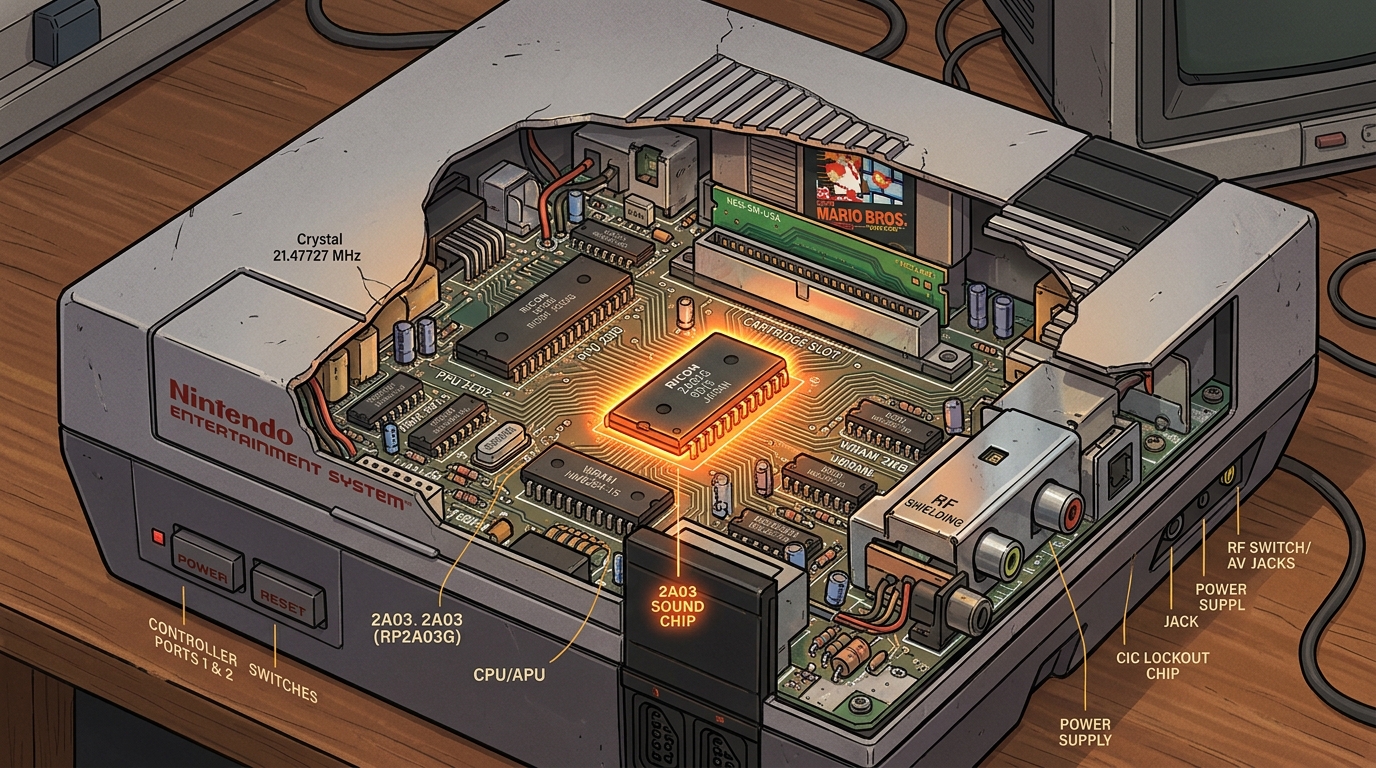
Ricoh 2A03 — A Tiny Orchestra Divided into Five Channels
The sound chip in Nintendo's Famicom (known as the NES in North America) is the Ricoh 2A03. The CPU and sound unit are packaged together, and the sound section consists of five channels: two pulse (square wave) channels, one triangle wave channel, one noise channel, and a DPCM (Delta Pulse Code Modulation) channel.
The two pulse channels typically handle melody and harmony. Because square waves have almost no even harmonics and only odd harmonics stand out, they produce that distinctive sharp "beep" timbre. The triangle wave channel has a soft tone and is stable in the lower register, so it often handles the bassline. The noise channel produces pitchless noise, making it useful for sound effects like hi-hats, snares, and explosions. DPCM can play short samples, so it's used for kick drums and voice effects.
The key point is that each channel's role was essentially fixed. Composers weren't just dealing with a five-track sequencer—they had to solve puzzles like, "The bass has to go on the triangle wave. If there are two melody lines, I need both pulse channels. So how do I create harmony?" These constraints are the very starting point of chiptune composition.
💡 Practical Tip: If you want to give your own track a chiptune feel, start by limiting yourself to five instruments or fewer. Just distributing them as 1 bass, 2 melody, 1 drum, 1 effect gives you the skeleton of the NES sound.
The Game Boy Sound Unit — The Wave Channel as a Wild Card
The Game Boy, which dominated the handheld market, has a Sharp LR35902 CPU with an integrated sound unit. Its channel configuration is similar to but distinct from the NES: two pulse channels, one user-defined waveform (wave) channel, and one noise channel, for a total of four channels.
The biggest difference is in the third channel. While the NES used a fixed triangle wave, the Game Boy offers a wave channel where the user can draw and fill in a short 32-sample waveform directly. You can put a square- or sawtooth-like timbre on the bass instead of a triangle wave, or use it as a short melodic instrument. This flexibility is the decisive reason why Game Boy trackers like LSDj and Nanoloop later established themselves as live instruments.
On the downside, the Game Boy has no sample playback channel like DPCM. So drums have to be synthesized by combining the noise channel with quick pulse pitch slides. Compare the drum sounds of the NES and Game Boy side by side and the difference is obvious. The NES kick lands thick and heavy, while the Game Boy kick cuts off short and dry.
Understanding this difference explains why the same composition by the same composer sounds different on different systems. When the same game was released on both NES and Game Boy, one of the main reasons the BGM was arranged differently was precisely this difference in channel architecture and sound drivers. Of course, the composer's choices, cartridge capacity, and development schedule also played a role. Hardware constraints and musical choices aren't the result of just one factor.
PSG, VRC6, VRC7, FDS — Ways to Push Past a Single Chip's Limits
Other systems of the same era had their own sound chips. The Sega Master System used the TI SN76489 family, the MSX used the GI AY-3-8910/YM2149 family, and many arcade boards used one of these or a related chip. All of these fall into the PSG (Programmable Sound Generator) category. A PSG typically has three tone channels and one noise channel. With fewer channels than the NES and no dedicated triangle wave, the bass also had to be handled with a square wave, resulting in a flatter timbre.
The Famicom worked around this limitation by mounting expansion sound chips directly on the cartridge. Konami's VRC6 added two pulse channels and one sawtooth channel, bringing three extra channels on top of the original five. The sawtooth has richer harmonics than the square wave, making it well suited for lead sounds. This is why Akumajō Densetsu (Castlevania III) sounds sonically richer than other Famicom games of the same era.
Even within Konami's lineup, the VRC7 uses a different synthesis method. The VRC7 is a chip that provides 6-channel FM synthesis, capable of producing the complex harmonics of organs, brass, and electric pianos. A signature example is Lagrange Point. It's worth remembering that the waveform-based VRC6 (pulse and sawtooth) and the FM-synthesis-based VRC7, despite both being expansion sound chips, produce fundamentally different timbres.
Nintendo's own FDS (Famicom Disk System) adds a single user-defined wavetable channel. As a result, the Japanese soundtrack of The Legend of Zelda has timbral differences from the American NES cartridge version. Even with the same song and same composer, the impression changes depending on which chip plays it back.
💡 Practical Tip: When analyzing reference tracks, first identify which system and which expansion chip the music came from. Knowing the channel count and synthesis method is what lets you distinguish "what's a chip limitation" from "what's a compositional choice."
Turning Constraints into Weapons — Signature Tricks Invented by 8-Bit Composers
Arpeggio — Inventing Chords on a Single Channel
If you use both pulse channels for melody and counter-melody, you have no channels left for chords. So 8-bit composers chose to rapidly alternate the three notes of a chord on a single channel. By cycling through C-E-G every frame (1/60th of a second), the human ear perceives this as a tremulous chord. This is called arpeggio.
If you isolate the channels of Koji Kondo's Super Mario Bros. overworld BGM, the structure becomes clear. Pulse 1 is the main melody, Pulse 2 is the arpeggio for harmony, the triangle wave is the bass, and the noise channel handles drums. What sounds like a tremolo on one channel is actually a chord progression. Thanks to this technique, the NES sounds like a four-part ensemble despite having only five channels.
Speed is the key to arpeggio. Too fast and it sounds like noise rather than a chord; too slow and it sounds like a broken melody. In general FamiTracker community practice, 1–4 frames is the range that maintains the sense of a chord, with the ideal value depending on the BPM and mood of the song. In tracker software, the standard approach is to use a command like 0xy to specify the interval between notes in semitones and cycle through them rapidly.
💡 Practical Tip: If you want to mimic a chiptune feel in a modern DAW, try sequencing chord tones in order on a square wave synth at 16th- or 32nd-note intervals. Even with no post-processing, you'll reproduce the characteristic tremulous quality of NES chords.
Duty Cycle and Vibrato — Fine-Tuning to Change Timbre
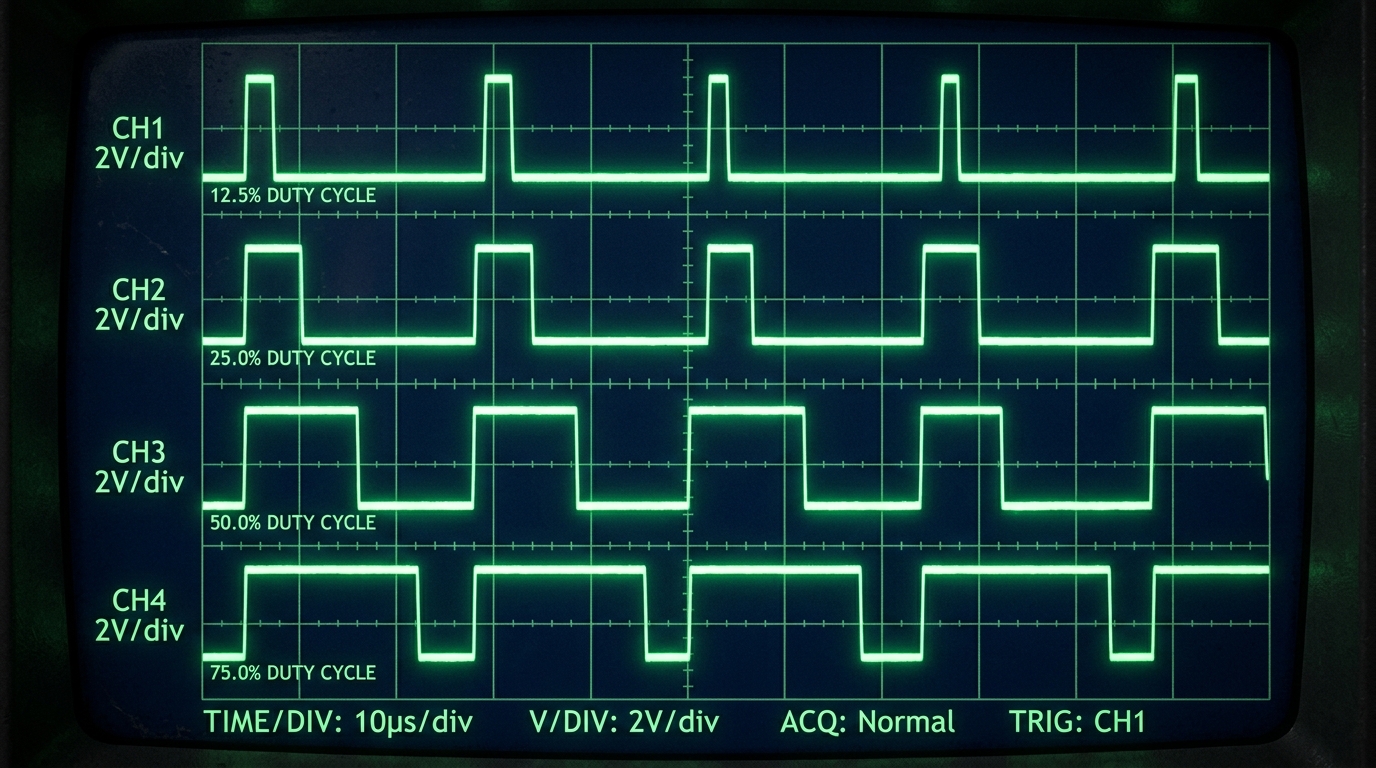
Pulse waves have a property called the duty cycle. It refers to the percentage of one period that the signal stays "high." The NES pulse channels support four duty cycles: 12.5%, 25%, 50%, and 75% (75% sounds identical to 25% but is phase-inverted). 50% produces a thick, rounded tone, while 12.5% produces a thin, nasal tone.
Composers switch duty cycles on a per-frame basis even within the same melody to vary the timbre. For instance, setting only the start of a note to 12.5% and then transitioning to 25% creates the impression of an accent on the attack. This is one of the reasons the lead sound in the Mega Man series doesn't sound monotonous.
Vibrato is a technique that rapidly oscillates pitch up and down. In chiptune, it's created by shifting the pitch value itself by ±1–3 units every frame. Pitch slides—rapidly sliding into the target pitch from above or below at the start of a note—are often used to create the attack of a drum kick or the "thump" of a bass. Most Game Boy kick drums are the result of a rapid downward pitch slide on a pulse channel.
Drum Synthesis and Loop Design — Composing While Saving Memory
The NES has no dedicated drum channel. While DPCM is sometimes used for sample drums, when conserving cartridge capacity or reserving DPCM for voice and sound effects, drum sounds have to be synthesized by combining the noise channel, triangle wave, and pulse. Snares are usually made with short noise bursts on the noise channel, and kicks are synthesized by applying a rapid pitch slide to the triangle wave. Hi-hats are expressed by cutting noise shorter and higher.
This creates a problem. If you use the triangle wave for the kick, the bassline stops at that moment. So NES composers design the bass pattern and kick pattern together. The bass might flow in eighth notes, briefly cutting off on beats 1 and 3 so the kick can come in. The reason this pattern sounds familiar is that we've heard this same structure repeated across hundreds of NES games without realizing it.
Memory conservation was also part of composition. Famicom cartridges typically allocated only a few dozen KB at most to sound data. So composers had to repeat short motifs and reference the same data for choruses to save space. Super Mario's overworld BGM is also constructed by varying a short hook motif throughout the entire piece, and this structure is what makes the "hook" so strongly dominate the listener's memory.
This is where beginners and experts diverge. Beginner chiptune composers try to fill all channels simultaneously. The result is channel collisions and intrusive click noise (the digital noise that occurs at the start and end of notes). Experienced composers intentionally leave channels empty. When the bass rests, the melody is emphasized; when the melody rests, the drums stand out.
💡 Practical Tip: To reduce channel collisions, leave one frame at volume 0 when ending a note on a channel. This reduces click noise and makes the attack of the next note clearer.
Indie Games and Festivals Revived Chiptune — The Resurgence After the 2000s
The People Who Turned Trackers and Game Boys into Instruments
In the early 2000s, chiptune began to separate from game music nostalgia into a standalone music genre. The decisive turning point was the spread of tracker software. FamiTracker faithfully recreates the NES/Famicom sound chip on a PC, letting you compose music with it. Data entry is done in a vertical table format, with each channel's notes, volume, and effect commands written in hexadecimal. The barrier to entry is high, but it has the strength of being exportable as NSF files that can actually play on real NES hardware.
On the Game Boy side, LSDj (Little Sound DJ) and Nanoloop took root. Both are music-making tools that load as firmware onto real Game Boy cartridges (ROM or flash carts). That means you can take a Game Boy on stage like a MIDI controller and perform live. It's the moment the game console becomes the instrument itself.
The Blip Festival, which began in New York in 2006, was the focal point of this movement. Organized by 8bitpeoples and others, it grew into an international event that brought chiptune artists together in one place, and the official festival series came to an end with the 2012 Tokyo event. Artists took the stage holding Game Boys, NES consoles, and Commodore 64s, filling the venue like an EDM festival. This created the recognition that chiptune isn't just retro sound but a club sound you can enjoy live.
This movement produced two changes. First, chiptune artists started to emerge as a viable profession. Second, game sound designers began to re-recognize chiptune as a tool of expression.
How Indie Game Soundtracks Use Chiptune
With the rise of indie games in the 2010s, chiptune became one of the major options for soundtracks. The approaches vary from game to game.
Shovel Knight (2014, Yacht Club Games) is an example of faithful recreation of the NES era. Composer Jake Kaufman (stage name Virt) composed the soundtrack to the VRC6 expansion audio specification. That means he borrowed the 8-channel environment that Konami used in the late Famicom era. Because of this, Shovel Knight's BGM can play on a real NES, and it was even distributed separately in NSF format.
Undertale (2015, Toby Fox) takes a different approach. The timbre resembles chiptune, but in reality, many tracks are produced in modern DAWs. While it actively uses square and sawtooth synths, there's no channel count limit. Multi-layered tracks, reverb, and modern drum samples mix freely. It's a method that consciously blurs the line between "chiptune-like timbre" and actual chiptune.
The Celeste (2018) soundtrack was created by composer Lena Raine and leans closer to electronic/post-rock than chiptune. However, chiptune-style square wave leads appear in boss battles and the latter sections to emphasize the game's identity and atmosphere. It's a case of using chiptune not as a genre but as a "tool for the scene."
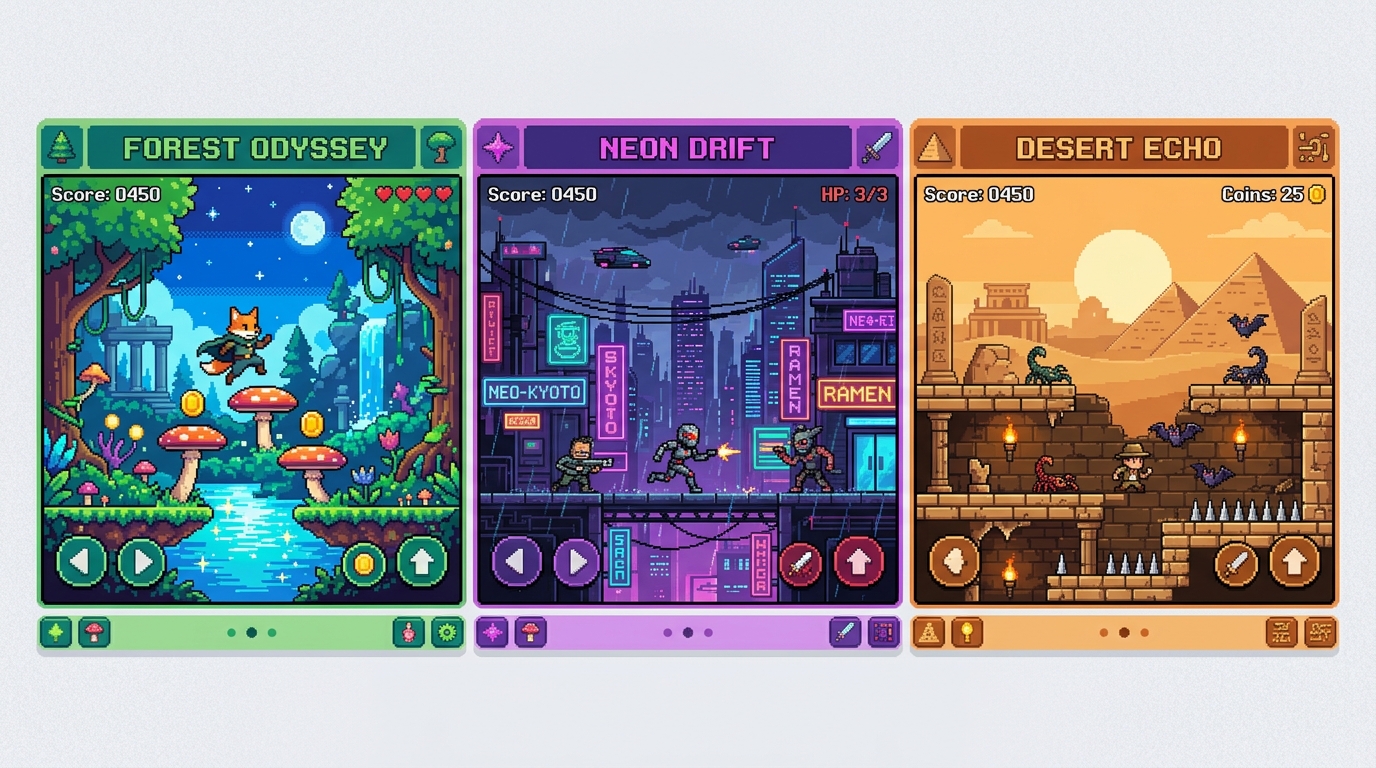
Lining these three up side by side gives you a sense of chiptune's position in indie game soundtracks. It's a spectrum that runs from full recreation to hybrid to partial quotation.
Neo-Chiptune and Beginner Workflow
Modern chiptune artists are no longer confined within NES channel constraints. Anamanaguchi combines NES sound with a live rock band setup. Pulse wave melodies are played alongside electric guitar, bass, and acoustic drums. Chipzel works by layering strong EDM structures over tracks made with Game Boy LSDj, and gained recognition through the soundtracks for Super Hexagon and Dicey Dungeons.
This trend is called "neo-chiptune" or "chiptune-influenced music." The key point is that they pull in 8-bit timbres as an aesthetic choice while handling composition and mixing to modern standards.
If a beginner wants to make their first chiptune track, the following four steps are realistic:
Tool selection: Choose one of FamiTracker (NES), DefleMask (multi-chip support), or LSDj (real Game Boy hardware). DefleMask is friendlier if you're used to mouse input, and FamiTracker if you're comfortable with keyboard shortcuts.
Reference analysis: Pick one of your favorite chiptune tracks and listen to it with channels separated. Players like NSFPlay offer channel-mute functionality. Use your ears to identify where the bass is and where the harmony is.
8-bar loop: Make an 8-bar loop using just three tracks: bass, melody, and drums. Don't try a full song from the start.
A/B comparison: Listen to your loop and the reference alternately. If there's a timbral difference, adjust the duty cycle; if the rhythm feels monotonous, adjust the arpeggio speed.
💡 Practical Tip: The most common mistake at the beginner stage is writing the melody too long. Chiptune runs on variations of 4–8 bar motifs. Start by practicing how to fill 8 bars by varying a single 2-bar hook in different ways.
From Pop to Commercials — The DNA Chiptune Left in Popular Music
8-Bit Timbres Seeping into the Mainstream Charts
Chiptune-style timbres have left their mark on chart music as well. Crystal Castles is an electronic duo from Toronto, Canada, who began their activity around 2004–2005, and their early work heavily utilized low-bit hardware like the Atari Punk Console and Game Boy. The harsh square wave sound of their 2008 self-titled debut album helped solidify the category of "lo-fi electronic" in both the electronic scene and indie rock.
Kesha's "Tik Tok" (2009) features a short 8-bit-style square wave motif in its intro. While the song as a whole can hardly be called chiptune, it's a case where the intro timbre determines the first impression of the song. It shows that even when a chiptune-style sound doesn't dominate the entire song and is used only as a "sound signature," it can still produce a strong effect.
On the Japanese side, YMCK is a representative example. It's a Shibuya-kei-style group that uses Famicom sound sources as-is while adding vocals on top, combining chiptune with J-pop vocal lines. In Korean popular music, it's rare to find songs entirely composed of chiptune; instead, it's more common to see square wave synths quoted as a sound signature in some indie tracks or game OST remakes.
There's one point worth noting here. We should be careful with the question, "Is every song that uses a square wave a chiptune?" In the narrow sense, chiptune is "music made with an actual sound chip or its accurate emulation," while in the broad sense, it's "music that borrows the timbre and compositional techniques of the 8-bit era." Most examples in chart music and commercials fall into the latter category—closer to chiptune-style or 8-bit-style synth.
Commercials and UX Sound — Chiptune as a Nostalgia Trigger
Chiptune-style timbres can be especially effective in commercials and video music. There are two reasons. First, in commercials that need to leave a strong impression in 5–10 seconds, square wave melodies are easily distinguishable because their timbre differs from other commercials. Second, for viewers who experienced games in the 1980s–90s, they can function as a nostalgia trigger.
Let's sketch a hypothetical scenario. Suppose a mobile game company is making an ad for a new casual puzzle game. Two options for the music are on the table. Option A is a modern electronic track, Option B is a 4-bar 8-bit-style square wave motif. The modern track is polished but has a timbre similar to dozens of other commercials. The 8-bit motif is rougher but quickly implies the context of "game commercial." Which one is better for brand recall depends on the campaign goals and target audience, but in terms of differentiation, the chiptune-style approach clearly holds potential.
There are similar possibilities in UX sound. You can see examples of short chiptune-style motifs being used for mobile app notification sounds and in-game UI effects. They're short, highly identifiable, and when expressed as sequence data, they can be stored much more compactly than audio samples. However, in actual mobile apps, pre-rendered WAV/OGG/MP3 effects are more commonly used, so it's important to distinguish between "chiptune timbre" and "chip data format."
💡 Practical Tip: When making a brand sound logo, compress it to a 3–5 note motif, 1–2 seconds long. Chiptune timbres are stronger the shorter they are. Making them too rich causes the music to compete with the commercial's message.
Where Is Chiptune Headed in the AI Music Era?
Chiptune fits the AI era well in two respects.
First, the data size is small. Formats like NSF and VGM are closer to chip-control and sequence data than rendered audio, so they can be stored much more compactly than MP3 or WAV of equivalent length. Since the encoding methods are fundamentally different, simple multiplier comparisons depend on the song and whether the driver is included, but it's clearly an attractive property for interactive music on mobile and web.
Second, it's easy to train on as structured data. Chiptune is essentially sequence data. Channels, pitches, volumes, and effect commands are arranged in a table format. This is a form that sequence models like Transformers can learn well from. In fact, music generation research using NES soundtrack datasets (such as NES-MDB) has been ongoing in academia.
One common misconception is that "chiptune is just retro." The comparison in the table below makes the difference clear.
Aspect | Simple Retro Style | Modern Chiptune |
|---|---|---|
Motivation | Nostalgia trigger | Aesthetics of timbre and structure |
Tools used | Virtual instrument presets | Real chips or accurate emulation |
Channel constraints | None (loosely imitated) | Consciously applied |
Application | BGM, commercials | Live performance, games, research |
Chiptune isn't a genre that has preserved past timbres in amber—it's "a compositional tradition that embraces constraints as aesthetics." With this perspective, the amount of information you can hear from a single square wave changes.
💡 Practical Tip: If you're using chiptune for learning purposes, try working with original sound chip data formats like NSF and VGM. Compared to WAV/MP3, the musical structure (channels, pitches, durations) is explicitly exposed, making it easier to handle for both analysis and generation.
How to Transplant Aesthetics Born from Constraints into Your Own Work
Chiptune is a compositional language invented out of hardware-imposed constraints. Limited materials—5 channels, square waves, triangle waves, and noise—gave birth to tricks like arpeggios, duty cycle switching, and pitch slides. Those tricks are still alive and moving today in indie game soundtracks, commercial music, live festivals, and AI music generation research. Listening to chiptune is ultimately listening to how much can be made from how little.
Let me propose one small action you can take right now. Download FamiTracker or DefleMask for free, and try sequencing a single 2-bar melody on a single pulse channel. Five notes are enough. Listen to the same melody with only the duty cycle changed, and you'll understand at once why chiptune composers spent time on these small choices.
Constraints are not the enemy of creation—they are the source of identity. What chiptune composers accomplished within 5 channels, we too can accomplish within the constraints of our own work. May good music and good tools always be with you.