

Why Localization and Professional Voice Dubbing Matter Beyond Simple Translation
2026.01.18·Study·9 min readMUZIUM
Also available in:
English···

Have you ever received disappointing results after a global launch? You were confident the language translation was perfect, yet feedback from international users was lukewarm or full of comments like "this feels awkward." App store reviews might even include harsh criticism like "this looks like it was run through a machine translator." This is the moment when a complacent approach — thinking it's enough to simply convey the meaning of the text — ends up wasting an enormous marketing budget.
Language is not merely a vehicle for conveying information; it is a vessel that holds the culture and emotion of a nation. The decisive factor in getting users to immerse themselves in content and open their wallets is "how natural it feels." Today, we will clearly examine the critical difference between simple translation and Localization, and why professional voice actor dubbing is an essential investment that breathes life into your content.
1. Simple Translation vs. Localization: Transplanting Culture, Not Just Language
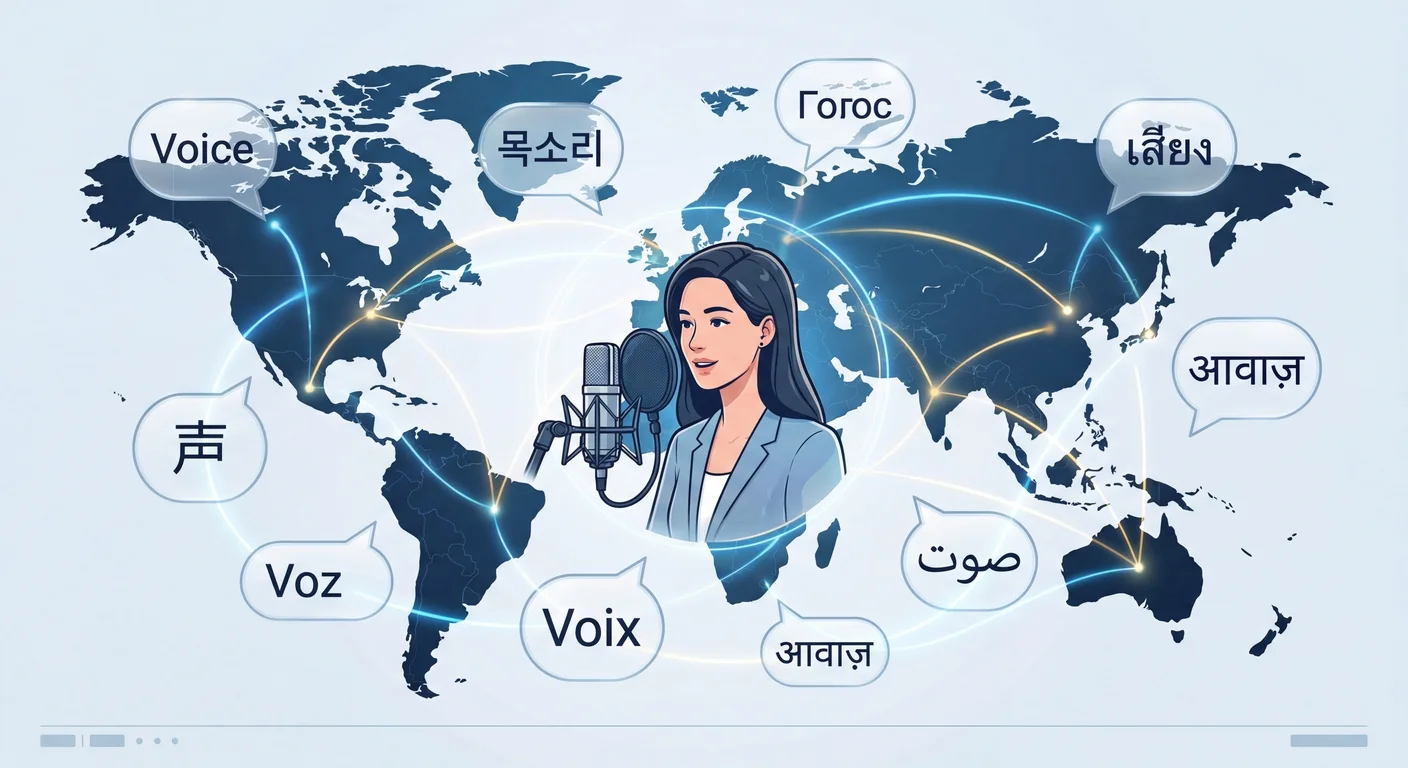
The most common mistake many companies make is treating translation and localization as the same thing. Translation is a linguistic conversion process that transforms the text of a source document into the text of a target language. Localization, on the other hand, is a comprehensive process of restructuring content by taking into account the cultural, legal, and technical environment of the target market. If translation is about changing the "words," localization is about making them resonate with the "hearts" of the people in that country.
For example, directly translating humor or idioms from an American game into Korean can fail to land emotionally or even cause misunderstandings. If "It's raining cats and dogs" were translated literally, users would be left confused. Rendering it as a vivid, contextually appropriate equivalent in the target language — one that carries the same expressive weight — is precisely what reflecting cultural context means. In this way, localization is a creative discipline: it grasps the original intent and recreates the content so that users in the target culture experience the same emotion and enjoyment.
Furthermore, localization encompasses non-linguistic elements as well. Date formats (MM/DD vs. DD/MM), currency units, the symbolic meanings of colors, and the cultural interpretation of gestures are all factors to consider. A gesture that is positive in one country may be deeply offensive in another. Overlooking these details can do more than just make content appear low quality — it can inflict serious damage on your brand image. Successful content globalization starts with breaking down these cultural barriers.
💡 Pro Tip: Leverage the target country's memes. Appropriately incorporating the latest slang and memes from the target market into the localization process can create a powerful sense of familiarity, making users feel, "This company truly understands our culture." However, since trending expressions have a short lifespan, it is best to apply them to content that can be continuously updated. Of course, moderation is key.
2. Text Informs, Voice Persuades: The Power of Professional Voice Actor Dubbing
Even with stunning graphics and a compelling story, the sense of immersion can shatter instantly if a character's voice feels off. The subtle tremor of emotion, a sarcastic tone, or a breathless sense of urgency — things that text subtitles alone cannot convey — can only be realized through **voice over**. In games, animation, and drama-style advertisements in particular, a voice actor's performance is a core element that defines the quality of the content.
There is a world of difference between an ordinary person simply reading a script and professional voice actor dubbing. A professional voice actor is a performer trained in the specialized technique known as "mic acting." They do not simply possess a pleasant vocal tone; they create an auditory sense of space through precise mic distance management, plosive control, and breath length. When conveying sadness, for instance, rather than merely making a crying sound, they express a character's inner psychology through suppressed breaths or a trembling final note. These accumulated details are what lead users to perceive a character as a living, breathing person.
Recent research shows that content with native-language dubbing has significantly higher user retention rates and playtime than content with subtitles alone. This is because cognitive load on the brain is reduced when visual information (the screen) and auditory information (the voice) are in sync. Preventing users from missing on-screen direction because they are busy reading subtitles, and allowing them to become fully absorbed in the content itself — this is the business value that professional dubbing delivers.
3. The Technical Expertise of a Sound Studio: The Engineering That Completes Quality
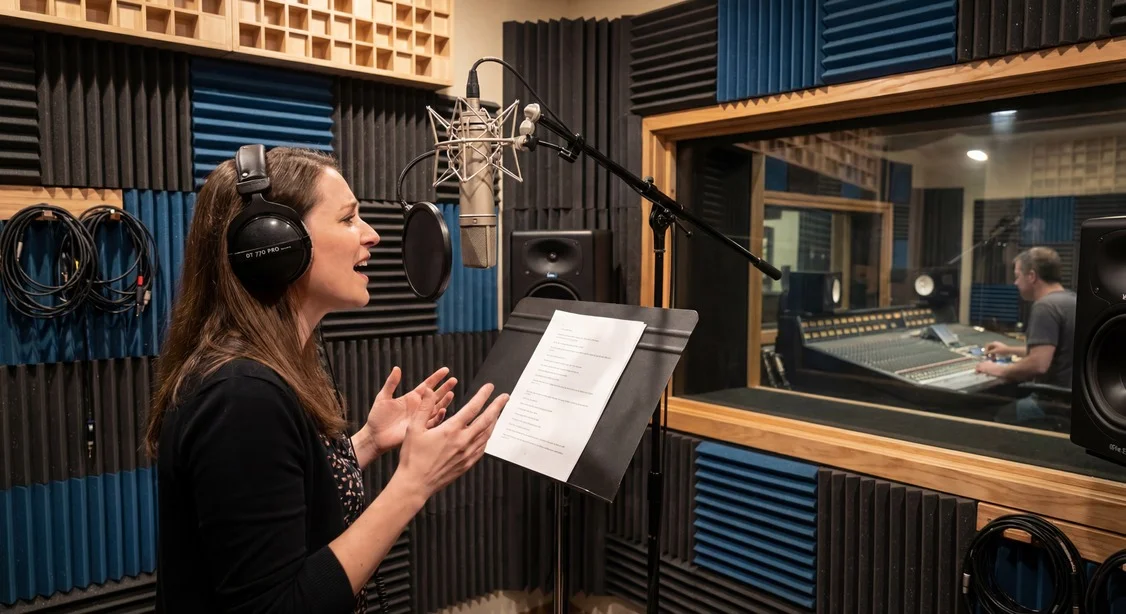
Securing a great voice actor is not the end of it. How that voice is captured and processed determines the quality of the final product. A professional sound studio is far more than a simple recording space. It requires rigorous soundproofing and acoustic treatment, hardware such as microphone preamplifiers and compressors optimized for the voice actor's vocal tone, and the skilled sound engineers who operate them.
There are technical challenges that home recording setups or budget studios simply cannot resolve. The most notable are lip-sync and time constraints. Recording translated dialogue with precise timing to match the character's lip movements or the length of lines in the original video is a highly technical undertaking. Engineers make minute adjustments to breath segments through waveform editing, or direct voice actors in real time to modulate their pace, creating a perfect unity between video and audio.
The processes of mixing and mastering are equally important. The background music (BGM), sound effects (SFX), and the voice actor's vocals must be balanced so that each element sounds crisp and distinct, rather than muddled together. The core of engineering lies in ensuring that sound is delivered clearly and without distortion across a variety of listening environments — mobile device speakers, earphones, TVs, and more. If this process is skipped, dialogue can sound muffled or get buried under the background music, severely degrading the user experience.
💡 Pro Tip: Capture "wild lines" during your session. In addition to the scripted dialogue, take time during the studio recording session to capture a variety of non-verbal sound sources (wild lines) — such as the character's battle cries, breathing sounds, laughter, and specific exclamations. These will prove extremely useful during the editing phase when adjusting video length or transitioning between moods.
4. Casting Direction: Finding the Voice That Fits Your Brand Persona
Voice actor casting is not simply about finding a "good voice." It is the process of finding a voice that aligns with the unique identity — the "persona" — of the brand or content. Casting a mellifluous voice actor for a rough warrior character in an action game, or hiring a voice actor with an overly playful tone for a financial app advertisement where trust is paramount, can undermine not only immersion but brand credibility as well.
Professional agencies leverage extensive voice actor databases to propose the optimal candidate by comprehensively considering a character's age, personality, regional background, and accent. For global projects in particular, it is important to reflect the cultural preferences of the target country. For example, in North America, a somewhat lower and deeper female voice tends to convey trustworthiness, whereas in Asia, there is a tendency to prefer a clear and bright tone. The ability to identify these cultural nuances and cast accordingly is a hidden driver of global success.
When multiple roles are involved, the ensemble of voices among the cast must also be considered. If all voice actors share a similar tone, it becomes difficult to distinguish between characters. High and low registers, husky and clear tones must be thoughtfully arranged to create an auditory sense of depth. The director orchestrates this balance in real time on the recording floor, serving as a guide to ensure each voice actor stays true to the emotional arc of their character.
5. LQA (Linguistic Quality Assurance): The Last Line of Quality Defense
The localization process is not complete just because recording and editing are finished. The most critical stage — **LQA (Linguistic Quality Assurance)** — still remains. LQA is the final review process that verifies whether the translated text and recorded audio have been applied contextually and appropriately within the actual game or video environment.
It goes far beyond simply catching typos, focusing intensively on elements such as the following:
Text Overflow: Does the translated text stay within the bounds of UI buttons or dialogue bubbles without overflowing?
Contextual Inconsistency: Does a character who was speaking formally suddenly shift to an informal register, or perform in a tone that does not fit the situation?
Variable Handling: Are in-game code strings such as '{User_Name} has entered' correctly substituted and displayed as readable text?
In the case of audio LQA specifically, it verifies whether subtitle and audio content match, and whether incorrectly linked audio files cause the wrong character's voice to play. Launching without this process, only to discover a critical error after release, means not only deploying development resources for an emergency patch but also failing to prevent the loss of early users. LQA is not a cost — it is the most affordable insurance available for preventing risk.
💡 Pro Tip: Make your LQA sheet as detailed as possible. Simply telling a tester to "play the game and find errors" will result in many things being missed. Provide a structured bug report template that includes screenshots, reproduction steps, expected results, actual results, and severity levels (Critical/Major/Minor) to facilitate efficient communication.
6. Conclusion: Localization Is Not a Cost — It Is the Most Powerful Marketing Investment
We have examined why professional localization and voice actor dubbing are essential, going far beyond simple translation. Users in the global market are raising their expectations every day, and clumsy localization is quick to be ignored. Localization that transcends language barriers and delivers genuine emotion is the magic that makes your content feel not like a "foreign product" but like "something of our own."
To summarize:
Cultural Transplantation: What is needed is not simple translation, but localization that reflects the sensibilities and culture of the target country.
Maximizing Immersion: The performance of professional voice actors and the technical expertise of a studio determine the vitality and immersiveness of content.
Rigorous Verification: LQA must be used to eliminate contextual errors and technical defects before launch.
Now is the time to take a hard look at your own content. Are you simply changing the language, or are you dressing it in a new culture? If you want to capture the hearts of global users, start right now by partnering with a professional localization partner to elevate the caliber of your content. The difference in small details creates the vast difference in global success.