

LUFS: The Complete Guide to Global Loudness Standards for Sound Localization
2026.01.18·Study·9 min readMUZIUM
#lufs#sound localization#audio mastering#loudness standard#loudness normalization#youtube audio#netflix audio standard
Also available in:
English···

Have you ever uploaded a carefully crafted global campaign video to YouTube or Netflix, only to find the audio sounding unusually quiet or lifeless? Or perhaps you've received feedback that the dubbed audio volumes vary so much between countries that it disrupts viewers' immersion?
This isn't a problem that can be solved simply by turning up the volume knob. It's a technical issue rooted in a lack of understanding of Loudness and LUFS. During the era of the "Loudness War," cranking up the volume at all costs was considered a virtue — but that's no longer the case. Every platform now enforces strict Loudness Normalization rules.
To stay competitive in the global market, sound quality and a consistent listening experience are just as essential as stunning visuals. Today, we'll take an in-depth look at the concept of LUFS — the key metric that determines the quality of sound localization — along with platform-specific standards and the professional audio mastering strategies needed to achieve them.
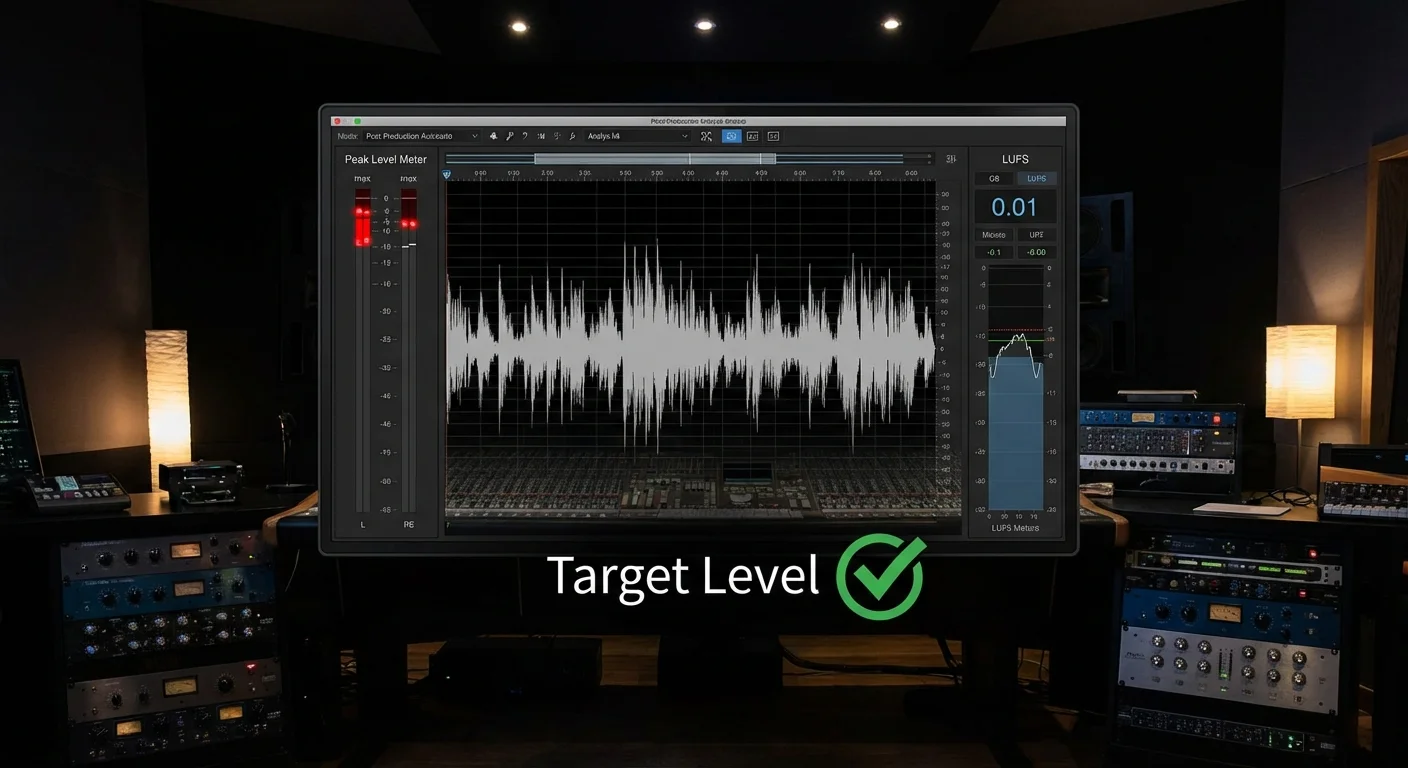
1. What Is LUFS, and Why Should You Focus on LUFS Instead of dB?
If you've worked with audio before, you're probably familiar with dB (decibels). But in the age of digital streaming, the true standard is **LUFS (Loudness Units Full Scale)**. These two units measure sound in fundamentally different ways.
The traditional dB — specifically **dBFS (Decibels relative to Full Scale)** — measures the highest instantaneous peak of an electrical signal. In other words, if there's a sudden loud "bang" at any given moment, that audio file will register a high dB value. However, the human ear doesn't perceive loudness based on momentary peaks — it perceives it based on the average energy heard over a period of time. This is exactly where the phenomenon occurs where peak levels are high, yet the audio actually sounds quiet.
By contrast, LUFS measures loudness in a way that reflects how the human auditory system perceives sound. It applies frequency weighting to the ranges our ears are most sensitive to and calculates the average loudness over time. As a result, LUFS values most closely correspond to how loud something actually sounds to a listener. In the sound localization process, matching only peak levels can lead to perceived volume differences due to the distinct phonetic characteristics of each language — but when levels are aligned using LUFS, viewers perceive the same loudness regardless of the language.
Why does this matter? Because the environments in which content is consumed have become increasingly diverse — mobile devices, TVs, earphones, and more. Viewers strongly dislike having to adjust the volume for every video they watch. Managing integrated loudness via LUFS is both the first step toward providing a comfortable listening experience and a fundamental sign of professional content production.
💡 Pro Tip: Simply raising the master fader during the mixing stage is not enough to achieve an appropriate LUFS level. You must use a compressor and a limiter to control the dynamic range (the difference between the quietest and loudest parts of the audio) in order to reach your target LUFS without sacrificing audio quality.
2. The "Loudness Mismatch" Problem in Sound Localization
One of the most commonly overlooked challenges in global projects is the difference in acoustic characteristics between languages. The source language, English, and target languages such as Korean, Japanese, and German each concentrate their energy in different frequency ranges. Applying the same settings mechanically without accounting for this will result in serious quality degradation.
For example, English features many consonantal plosives and fricatives, giving it strong high-frequency energy, whereas Korean, with its vowel-heavy phonetics, may exhibit more prominent energy in the low-to-mid frequency range. If the original English audio is at -14 LUFS and you simply adjust the volume of the Korean dub to match -14 LUFS, the overall balance can fall apart. The Korean dubbing might get buried under the background music (BGM) — or, conversely, it might stick out too much and feel jarring.
Furthermore, the performance style of voice actors also affects integrated loudness values. Some voice actors perform with a wide dynamic range, while others perform with a narrow one. Localization engineers must carefully calibrate the loudness normalization of each language's dubbed audio so that viewers experience the same seamless mixing balance no matter which language they switch to.
Ultimately, the essence of sound localization is not mere translation — it is the "translation of sensation." The mark of true technical expertise lies in ensuring that the tension and atmosphere the original creator intended are conveyed with the same audio pressure and nuance in every language. In this process, LUFS metering becomes the most powerful tool for supplementing an engineer's ears with objective, measurable data.
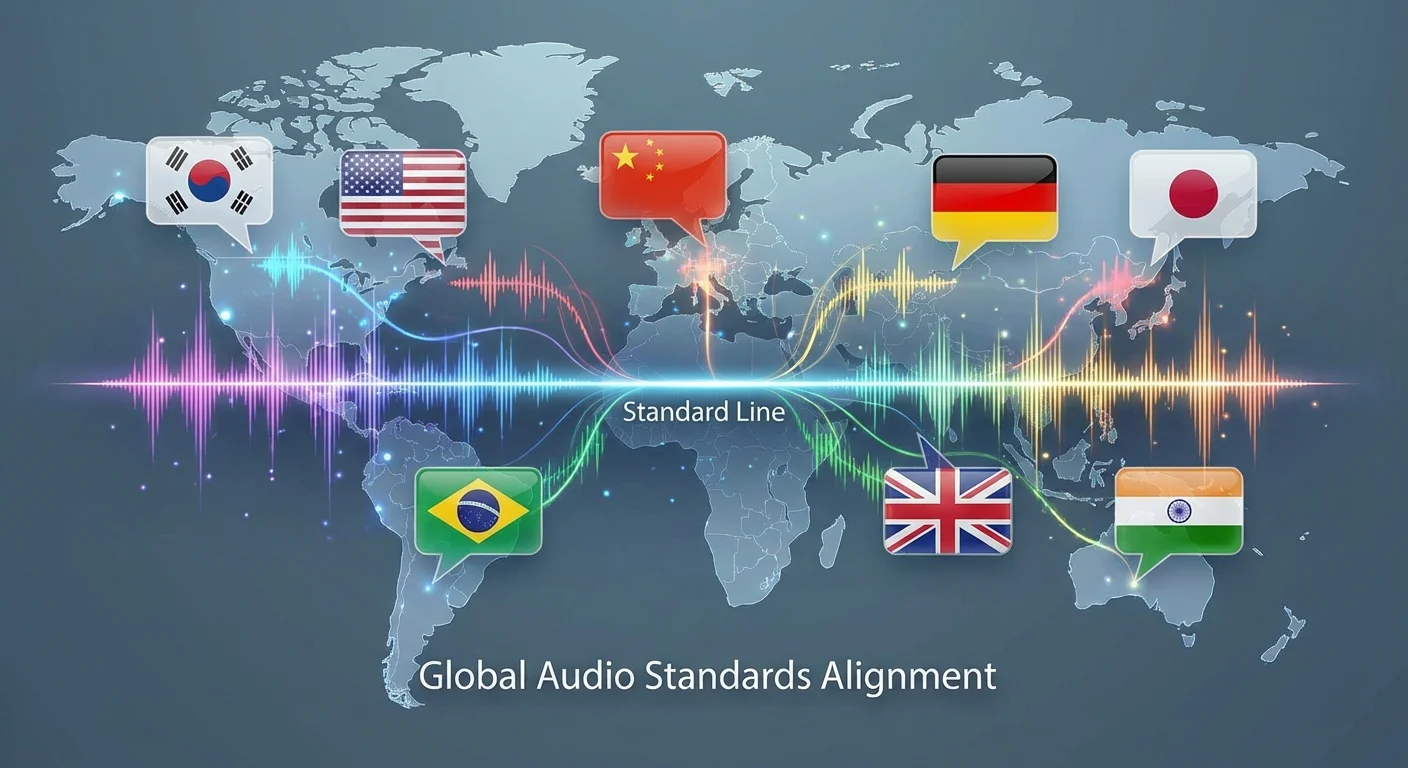
3. Platform-Specific Loudness Standards and the Fear of "Penalties"
Every platform where your content is uploaded has its own loudness standard. Fail to comply, and the platform's algorithm will forcibly manipulate your audio. This is often referred to as a "penalty," and it can result in compromised sound quality.
The most well-known example is **YouTube**, whose standard is -14 LUFS. What happens if you upload a file mastered at a very loud -8 LUFS? YouTube will detect this and forcibly reduce it by 6dB. The problem isn't just that the volume drops — the intended impact and punch of the sound can end up feeling weak and lifeless. Conversely, if you master too quietly, YouTube will boost the volume, but this process risks amplifying unwanted noise along with it.
**Netflix**, the dominant force in OTT platforms, is even stricter. Netflix sets **-27 LUFS (+/- 2 LU)** as its standard, with specific guidelines requiring that the **True Peak** not exceed -2 dBTP (based on dialogue-gated measurement). This figure — close to broadcast television standards — is designed to preserve cinematic dynamic range. Submit a YouTube-spec file (-14 LUFS) to Netflix, and it will be rejected immediately during the quality review process.
Beyond these, **Spotify** targets -14 LUFS, Apple Music targets -16 LUFS, and the **broadcast TV standard (EBU R128)** calls for -23 LUFS. Global marketers and project managers need to determine in advance where their content will be distributed and prepare separate audio mastering versions tailored to each platform's specifications. The complacent assumption that "one file will work everywhere" can seriously damage your brand's image.
4. Key Metrics Explained: Integrated Loudness vs. True Peak
There are two specific metrics you absolutely need to understand for professional discussions: **Integrated Loudness** and **True Peak**. Without distinguishing between these two, communicating effectively with engineers becomes difficult.
Integrated loudness refers to the average loudness across the entire duration of a piece of content — from start to finish. It's the final value calculated by combining everything: the intro, quiet dialogue scenes, and loud action sequences. Platform requirements (e.g., -14 LUFS) are almost always based on this integrated loudness. When working on localization, the primary goal is to ensure that the integrated loudness of each language's audio track lands precisely on the target value across the full runtime.
True Peak, on the other hand, is a predicted value for the "actual peak" that can occur when a digital signal is converted to analog (D/A conversion). Even if a standard digital peak meter doesn't exceed 0 dB, clipping — where the audio literally distorts and tears — can still occur during playback through speakers. To prevent this, streaming platforms typically limit true peak to -1.0 dBTP or -2.0 dBTP.
Many non-specialists focus only on integrated loudness and overlook true peak, leading to audio degradation. Since peak levels tend to rise when encoding with lossy compression codecs such as MP3 or AAC, it's important to leave sufficient headroom for true peak during the mastering stage. This attention to detail is what sustains high sound quality.
💡 Pro Tip: Don't forget to check Short-term Loudness as well. Even if integrated loudness meets the target, if the volume spikes or drops sharply within a specific window (measured in 3-second intervals), viewers will feel uncomfortable. Keeping short-term loudness variations within a consistent range is the secret to polished, refined mixing.
5. A Recommended Workflow for Going Global
Successful global sound localization requires a structured workflow. It's not simply a matter of laying translated audio over video — consistent management is required from **pre-mixing all the way through mastering**.
First, clearly define your target platforms from the outset. At the project kickoff stage, determine whether the content is destined for YouTube, a TV commercial, or an OTT platform. If the content will be distributed across multiple channels, an efficient top-down approach is to first mix for the format with the widest dynamic range (e.g., TV/OTT), and then apply loudness normalization and limiting to derive an online version (YouTube/social media) from that master.
Second, make use of reference tracks. Analyze the LUFS values of competitors' global content or your own previously successful content. Don't just match the numbers — it's essential to also conduct comparative listening (A/B testing) to evaluate how the vocal clarity and the balance between voice and background music actually sound.
Third, conduct a thorough inspection using professional Loudness Meter plugins. Rather than relying on visual observation or gut feeling, use specialized tools such as Youlean Loudness Meter or iZotope Insight to generate a report on your final rendered files. This report serves as a verifiable proof of quality to present to clients or platform representatives. Professional agencies like ours subject every deliverable to this kind of technical verification to guarantee the integrity of the data.
6. Conclusion: Sound Is the Final Flourish of Quality.
We've now covered LUFS and loudness standards — the key metrics in sound localization. Here's a summary of the main takeaways:
LUFS is non-negotiable: Peak levels (dB) are no longer the benchmark. Work must be done using LUFS, which reflects how people actually perceive loudness.
Comply with platform standards: Ignoring the specifications of each platform — YouTube (-14), Netflix (-27), and others — will result in forced volume adjustments that degrade your audio quality.
The details of localization matter: Only precise, language-aware balancing that accounts for the phonetic characteristics of each language can deliver a consistent brand experience to global audiences.
If polished video editing and accurate translation are the body of your content, then proper loudness settings and sound balancing are the breath that brings it to life. When sound quality falls short, viewers instinctively perceive the content as "unprofessional" and disengage.
Take a moment now to revisit your YouTube channel or your global promotional videos. Is the audio too quiet? Is it distorting? If you're not sure, the fastest solution is to seek a professional assessment. With precise LUFS calibration and meticulous mastering, make sure your content sounds its very best on the global stage.